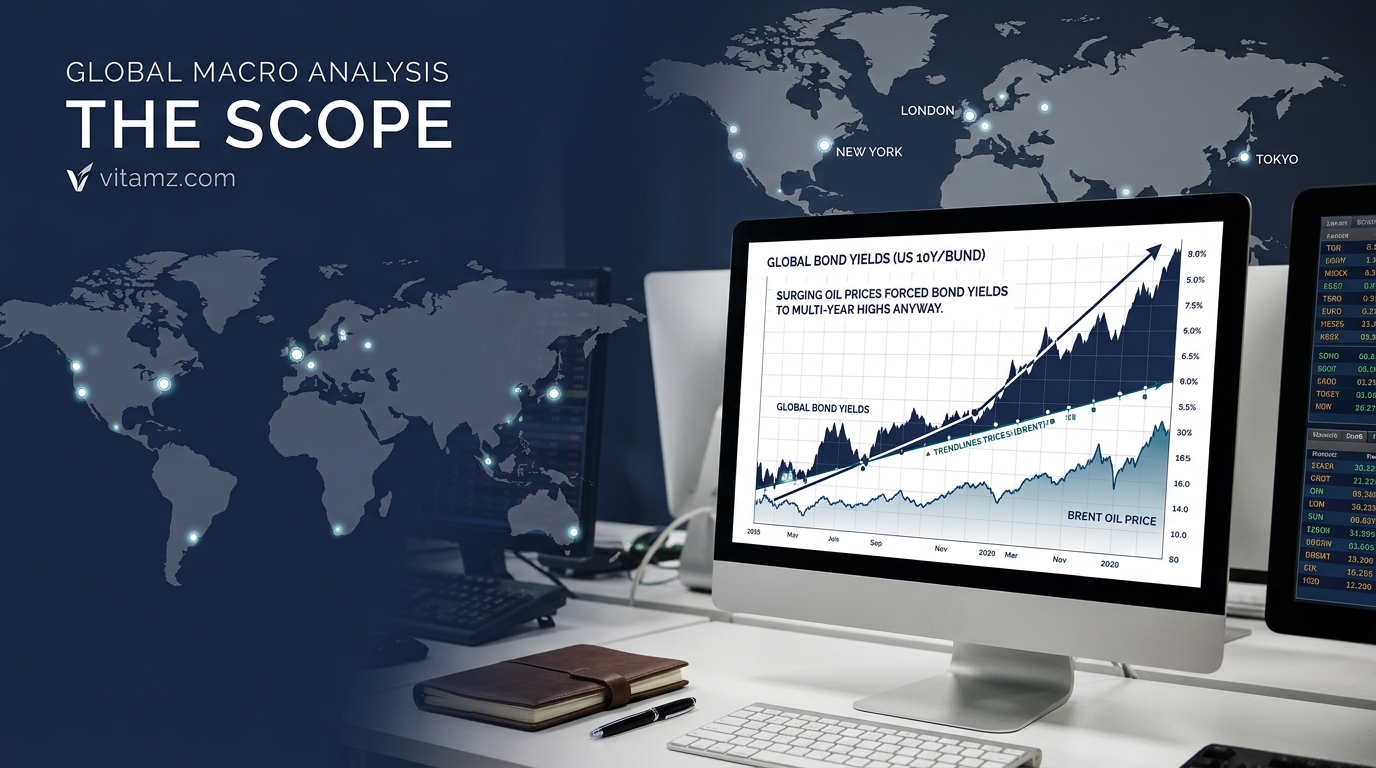
The script was flipped. Just as global central banks signaled a much-anticipated pause in their aggressive rate-hiking cycles, a renewed surge in commodity prices, driven by geopolitical turmoil, has thrown a wrench into the works. The result is a classic stagflationary shock, where slowing growth and accelerating inflation create a toxic brew for asset prices, forcing bond yields to multi-year highs despite policymakers’ intentions.
🌐 Macro Briefing
Global markets are navigating a treacherous path. The primary tension is between central bank rhetoric, which has cautiously pivoted towards a data-dependent pause, and the hard reality of a supply-side shock in energy markets. Escalating geopolitical risks in the Middle East, specifically threats to crucial shipping lanes like the Strait of Hormuz, have propelled WTI crude above $90 and Brent crude toward $100 per barrel.
This spike in oil prices is a direct challenge to the disinflation narrative that had been gaining traction. The bond market has reacted violently, with the 10-year U.S. Treasury yield (US10Y) surging to 4.703%, its highest level in over a year. Investors are now forced to price in the risk that inflation will prove more persistent, potentially forcing central banks to keep rates higher for longer or even resume hiking, a scenario that was unthinkable just weeks ago.
The risk-off sentiment is palpable across asset classes. The S&P 500 (SPY) dropped by -1.67% as investors grappled with the dual headwinds of higher borrowing costs and eroding corporate margins due to rising energy inputs. Meanwhile, the U.S. Dollar Index (DXY) has strengthened to 101.446, reflecting both a flight to safety and the widening interest rate differentials as U.S. yields outpace those in other developed markets.
🏦 Central Bank Watch
The oil shock has thrown global central banks into what has been described as an “uncomfortable territory.” They face the classic dilemma of a stagflationary shock: rising inflation suggests a need for tighter policy, while the hit to consumer spending and business investment from higher energy costs implies a need for looser policy. The timing is the fundamental challenge, as monetary policy works with a significant lag, whereas energy price shocks hit the economy almost instantly.
The Federal Reserve, now under the new leadership of Chair Kevin Warsh, is in a particularly tight spot. While recent progress on inflation had justified a pause, the renewed price pressures complicate the outlook. Markets are now pricing in a higher probability of a rate hike at the September meeting, a significant shift from just a week ago. Warsh’s immediate focus appears to be on re-anchoring the Fed’s commitment to price stability, which the market has interpreted as hawkish.
The European Central Bank (ECB) is also on high alert. Having recently raised its benchmark rate to 2.25%, it chose to hold steady at its latest meeting, acknowledging that the full impact of the energy shock has yet to materialize. However, with Eurozone inflation still well above the 2% target, ECB President Christine Lagarde has kept the door open for a September hike, stating the bank is not pre-committing to any path and will make decisions meeting-by-meeting. The Bank of Japan (BOJ), in contrast, is on a different trajectory, viewing higher oil prices and a weaker yen as supportive of its goal to exit a long period of disinflation and normalize policy.
💱 FX, Bonds & Commodities
The commodity market is where the geopolitical drama is playing out most vividly. WTI crude’s surge past $92 per barrel reflects acute fears of supply disruptions. Escalating tensions have led to attacks on oil tankers in the Red Sea and threatened the flow of nearly a fifth of the world’s oil supply through the Strait of Hormuz. This geopolitical risk premium is now firmly embedded in prices, compounded by rising summer fuel demand and tightening global inventories.
In the bond market, the reaction has been swift and severe. The U.S. 10-year Treasury yield’s climb to 4.703% reflects investors demanding higher compensation for the risk of resurgent inflation eroding their returns. This move has significant implications for the broader economy, as the 10-year yield is a benchmark for borrowing costs on everything from mortgages to corporate debt. Higher government deficits are also contributing to the pressure, as increased borrowing needs could lead to greater bond issuance.
The U.S. dollar has reasserted its dominance, with the DXY rising to 101.446. The dollar is benefiting from its safe-haven status and the perception that the U.S. economy is better insulated from the energy shock than Europe or Japan. In contrast, Gold (GLD) has also rallied, climbing 1.80% to $371.52, as investors seek refuge from both inflation and geopolitical uncertainty.
| Metric | Live Data | Strategic Read |
|---|---|---|
| WTI Crude (▲10.81%) | $92.23 | Geopolitical risk premium is back. Focus is now on the duration of supply disruptions in the Middle East. |
| US10Y Yield (▲3.57%) | 4.703% | Bond market is pricing in persistent inflation, challenging the Fed’s intended pause and raising borrowing costs globally. |
| DXY Index (▲0.45%) | 101.446 | Flight to safety and widening rate differentials are driving dollar strength, creating headwinds for emerging markets. |
| Gold (GLD) (▲1.80%) | $371.52 | The classic inflation and crisis hedge is performing as expected, attracting capital amid rising uncertainty. |
🌏 Global Ripple Effects
The combination of a stronger U.S. dollar and higher U.S. Treasury yields is a potent and often negative force for the rest of the world, particularly emerging markets (EMs). A 10% appreciation in the dollar can reduce economic output in emerging economies by nearly 2% after a year, a drag that can persist for over two years. These effects are transmitted through both trade and financial channels, as a strong dollar makes imports more expensive and tightens domestic credit conditions.
Countries with significant dollar-denominated debt face the double-whammy of higher servicing costs and the risk of capital outflows as investors are lured back to the safety and higher returns of U.S. assets. We are seeing this play out in real-time, with currencies like the Korean Won coming under pressure, with the USD/KRW rate now at 1475.28. Local equity markets also suffer, as evidenced by the KOSPI’s -2.57% decline.
This dynamic forces EM central banks into a difficult position. They must often raise their own interest rates to defend their currencies and prevent capital flight, even if their domestic economies are weakening. This can stifle growth and exacerbate financial stability risks, creating a feedback loop that weighs on the global economic outlook.
📅 What to Watch This Week
All eyes will remain on geopolitical developments in the Middle East, as any further escalation could add fuel to the fire in energy markets. On the central bank front, the Federal Reserve’s policy meeting next week will be critical. While a hike is not the baseline, the market is now pricing in a significant chance, and the tone of the statement and press conference will be scrutinized for clues on the path forward.
From a data perspective, upcoming inflation reports from the U.S. and Europe will be paramount. Any signs that the energy price shock is feeding into core inflation could embolden hawkish policymakers and send another wave of selling through bond and equity markets. Key releases to monitor include the U.S. Consumer Price Index (CPI), Producer Price Index (PPI), and the Eurozone’s flash HICP inflation estimate.
⚡ Bottom Line
The macro landscape has shifted abruptly. The era of predictable disinflation and a clear path to policy normalization is over, replaced by a volatile and uncertain environment dominated by a classic supply-side shock. The market is now caught between central banks that want to pause and commodity prices that are forcing their hand.
For investors, this calls for caution and a focus on resilience. The surge in bond yields makes fixed-income assets more competitive with equities for the first time in years, but the risk of further inflation-driven losses remains high. The strong dollar will continue to be a headwind for international equities and a source of stress for emerging markets, while gold may offer a valuable hedge against both inflation and geopolitical tail risks.
📋 Before the Open Checklist
- Fed Speakers & Meeting Minutes: Watch for any commentary from Federal Reserve officials reacting to the surge in oil and yields ahead of next week’s crucial FOMC meeting.
- U.S. Weekly Jobless Claims: A fresh read on the labor market will influence the Fed’s thinking on the economy’s underlying strength and its ability to withstand higher rates.
- Middle East Headlines: Any news related to shipping in the Strait of Hormuz or the Red Sea will directly impact oil prices and risk sentiment across all markets.
The read-through is clear: markets are on a knife’s edge, with the renewed threat of inflation forcing a repricing of interest rate expectations and challenging the outlook for global growth.
This content is for informational purposes only and does not constitute investment advice. Investment decisions are the reader’s own responsibility. The Scope assumes no legal liability for outcomes.