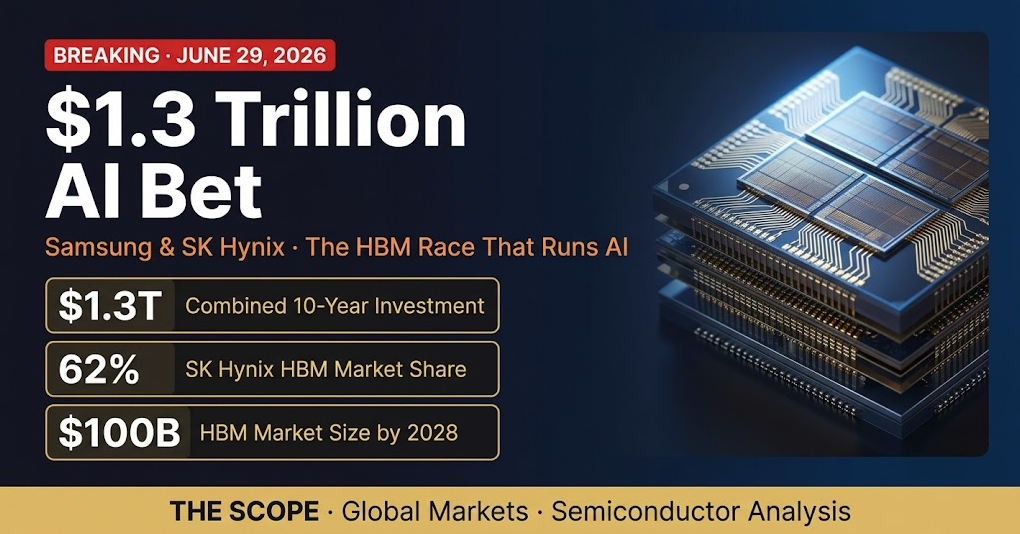
TOTAL INVESTMENT
$1.3T
Samsung + SK Hynix · 10-year plan
SK HYNIX HBM SHARE
62%
Global HBM market · NVIDIA’s #1 supplier
HBM MARKET 2028
$100B
Up from $35B in 2025 · ~40% CAGR
BREAKING · JUNE 29, 2026
The Announcement That Shook Global Markets This Morning
At 2:00 PM Monday Seoul time, South Korean President Lee Jae Myung convened a national briefing at Cheong Wa Dae — the Blue House — with the chairmen of Samsung Electronics and SK Hynix in attendance. What followed was the largest corporate investment commitment in South Korean history, and arguably the most consequential single announcement in the global semiconductor industry in years.
Samsung Group announced a 1,000 trillion won ($646 billion) investment package over the next decade. SK Hynix committed to a comparable figure. Combined, the two companies are pledging approximately $1.3 trillion — nearly equal to the entire GDP of Spain — toward expanding South Korea’s semiconductor and AI infrastructure. The centerpiece: four new semiconductor fabrication plants to be built in the country’s southwest Honam region, two by each company, as part of an 800 trillion won ($518 billion) national chip production ecosystem project.
Markets reacted immediately. Samsung Electronics shares fell 4.8% on the day. SK Hynix dropped as much as 6% before recovering to close down 1.6%. The reaction is a familiar pattern in capital-intensive industries: investors price in near-term dilution and execution risk before the long-term strategic value becomes clear. But to understand why this announcement matters well beyond South Korea’s borders, you need to understand what these companies actually make — and why the world cannot currently build AI without them.
HBM: The Chip the AI Revolution Cannot Live Without
To grasp the significance of this investment, you first need to understand High Bandwidth Memory — HBM. It is not the kind of chip that makes headlines in consumer electronics. There is no HBM in your smartphone or laptop. HBM is built for one purpose: feeding data to AI accelerators at speeds that conventional memory cannot approach.
Every NVIDIA H100 and B200 GPU — the chips that power the AI infrastructure buildout at Microsoft, Google, Amazon, and Meta — requires HBM to function. The GPU’s compute cores process data extraordinarily fast, but they can only do so if memory can supply that data at matching speed. HBM achieves this by stacking multiple DRAM dies vertically and connecting them through silicon vias, delivering bandwidths that standard DRAM cannot match: HBM3E reaches 1.18 terabytes per second per stack. HBM4, entering mass production now, targets 1.5 TB/s and beyond.
Without HBM, there is no AI at scale. The entire infrastructure buildout — the $1 trillion+ that hyperscalers are collectively spending on AI data centers through 2030 — is bottlenecked by how many HBM chips can be manufactured. And right now, two companies control that bottleneck: SK Hynix and Samsung Electronics.
SK Hynix: The Company That Dethroned Samsung
In Q2 2025, SK Hynix did something that had never happened before: it surpassed Samsung Electronics as the world’s largest memory chip supplier by revenue, posting $15.1 billion in quarterly sales. The driver was HBM — specifically, SK Hynix’s decision years earlier to bet heavily on high-bandwidth memory when Samsung was still focused on conventional DRAM and NAND.
That bet has paid off extraordinarily. SK Hynix holds approximately 62% of the global HBM market. NVIDIA — the most valuable semiconductor company in the world — relies on SK Hynix for roughly 90% of its HBM supply. The company’s entire DRAM, NAND, and HBM production capacity has been sold out through 2026. Goldman Sachs rates it the memory industry’s dominant force in HBM3 and HBM3E through at least 2026, with a total HBM market share forecast to remain above 50%.
The HBM4 transition — the next generation of high-bandwidth memory offering 1.5+ TB/s per stack — is already underway. SK Hynix has secured approximately 70% of NVIDIA’s HBM4 orders for the Vera Rubin platform, the AI accelerator generation that will power the next wave of data center expansion. The company recently announced a $29 billion US listing plan, signaling its ambition to become a global capital markets player, not just a Korean manufacturer.
SK HYNIX · KEY METRICS 2025
$15.1B
Q2 2025 revenue (record)
$8B
Q3 2025 net profit (+62% YoY)
62%
HBM global market share
SOLD OUT
All capacity through 2026
Samsung: The Giant Fighting to Reclaim Its Crown
Samsung’s position in HBM is a story of a near-miss becoming a crisis. The company was slow to prioritize HBM3E development — the generation that powers the current NVIDIA H100 and B200 wave — and its products failed NVIDIA’s quality testing at a critical moment in 2024. The result was a collapse in HBM market share from dominance to 17% by Q2 2025, as SK Hynix swept in to take the orders Samsung could not fulfill.
The recovery is underway, but it requires exactly the kind of investment Samsung announced today. NVIDIA and AMD have completed quality testing of Samsung’s HBM4 products, with formal supply expected to have begun in early 2026. Samsung Foundry — the contract manufacturing division — has won orders from Tesla for AI chip production, signaling that the broader ecosystem is regaining confidence in Samsung’s manufacturing quality.
Samsung’s $646 billion commitment is not simply a capacity expansion — it is a strategic statement that the company intends to fight for the HBM market rather than cede it. The investment covers new fabrication plants, advanced packaging technology essential for HBM production, AI data center development in the Chungcheong region, and physical AI infrastructure. For a company that has dominated global semiconductor manufacturing for decades, this is a defense of existential importance.
Why the Stock Prices Fell — And What It Actually Means
The immediate market reaction — Samsung down 4.8%, SK Hynix down as much as 6% — deserves explanation. It is not a vote of no confidence in the investment thesis. It is a rational short-term reaction to several compounding concerns.
First, capital intensity. Building semiconductor fabrication plants at this scale requires enormous upfront investment before a single chip rolls off the production line. Each new leading-edge fab costs $10–20 billion and takes three to five years to build and ramp. The return on that investment is real, but it is measured in years, not quarters — and equity markets discount future cash flows heavily when the timeline is uncertain.
Second, execution risk. Building four new fabs simultaneously, in a region that does not currently have the supporting infrastructure, supply chain ecosystem, or trained workforce at scale, is an enormous operational challenge. South Korea’s government has pledged to “drastically shorten the timeline from licensing to construction,” but regulatory and logistical bottlenecks in semiconductor construction are universal.
Third, supply overhang. If both companies successfully ramp the new capacity on schedule, the additional supply could weigh on memory prices in the early 2030s — the same oversupply dynamic that periodically devastates semiconductor margins. Memory markets are cyclical by nature, and investors are right to think carefully about where in the cycle this capacity will come online.
SHORT-TERM RISKS
- Capital intensity compresses near-term free cash flow
- Execution risk: 4 fabs simultaneously in new region
- Potential oversupply in early 2030s if AI demand slows
LONG-TERM OPPORTUNITY
- HBM market growing from $35B (2025) to $100B (2028)
- AI infrastructure demand structural, not cyclical
- Only 3 companies in the world can make HBM at scale
The Global Implications: Geopolitics, Supply Chains, and the AI Race
This investment does not exist in a geopolitical vacuum. The South Korean government’s decision to frame these commitments as “mega-projects for the great leap forward” reflects a national strategic calculation: in an era of US-China technology decoupling, South Korea’s position as the indispensable supplier of advanced memory chips gives it geopolitical leverage it intends to press.
The US needs South Korean HBM to build AI infrastructure. China needs it too — but increasingly cannot get it, as US export controls restrict the most advanced memory chips. Taiwan’s dominance in logic chip manufacturing (TSMC) and South Korea’s dominance in memory are the two most critical chokepoints in the global AI supply chain. Both countries are investing heavily to entrench those positions before the geopolitical situation evolves further.
For investors outside South Korea, the implications ripple through the ecosystem. NVIDIA’s ability to ship AI accelerators on schedule depends directly on SK Hynix and Samsung’s production capacity. Any disruption — a geopolitical incident, a natural disaster, a production yield problem at one of the new fabs — would create immediate supply constraints for the entire AI infrastructure build-out. Conversely, successful execution of this investment plan ensures that the memory bottleneck on AI expansion remains manageable through the end of the decade.
✦ THE SCOPE · KEY TAKEAWAYS
- Samsung and SK Hynix have announced a combined $1.3 trillion investment in South Korean semiconductor infrastructure — the largest corporate commitment in the country’s history, unveiled at a presidential briefing on June 29, 2026.
- The investment centers on four new fabrication plants in South Korea’s southwest, targeted at HBM and advanced AI chip production — the memory technology that makes every NVIDIA AI accelerator function.
- SK Hynix holds 62% of the global HBM market, supplies ~90% of NVIDIA’s HBM, and has its entire production capacity sold out through 2026. It is the most critical single supplier in the AI infrastructure supply chain.
- Samsung’s HBM share collapsed from dominance to 17% in 2025 due to quality issues, but recovery is underway — HBM4 supply to NVIDIA began in early 2026, and the Tesla Foundry win signals improving manufacturing credibility.
- The HBM market is projected to grow from $35 billion in 2025 to $100 billion by 2028. Today’s stock price decline reflects short-term capital intensity concerns — not a verdict on the long-term strategic logic of the investment.
This content is produced by The Scope for informational purposes only and does not constitute investment advice. All investment decisions are the sole responsibility of the reader. The Scope accepts no legal liability for actions taken based on this analysis.