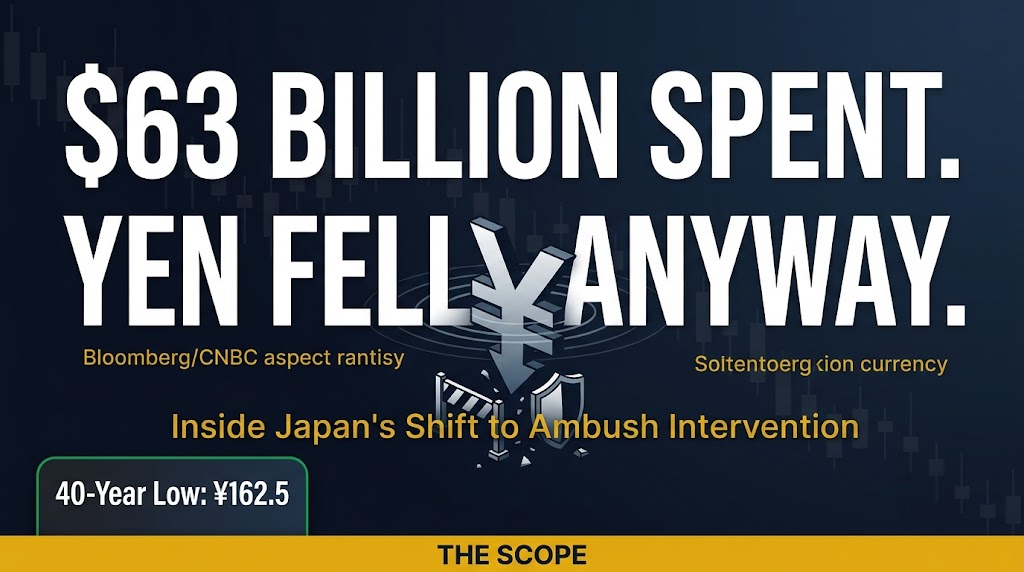
Japan Spent $63 Billion Defending the Yen. It Fell to a 40-Year Low Anyway.
Tokyo isn’t giving up — it’s changing tactics entirely, shifting from telegraphed intervention to unannounced ambush strikes aimed squarely at short sellers.
A $63 Billion Defense That Didn’t Hold
Between April 30 and May 6, during Japan’s Golden Week holiday period, Bank of Japan account data suggests authorities spent as much as ¥10 trillion — roughly $63 billion — defending the yen. At the time of that intervention, USD/JPY was trading near ¥161. Japanese officials never directly confirmed the action, but the price action during that specific window carried the classic signature of official buying that market participants have come to recognize.
The problem is that even a defense of this scale didn’t hold. After a brief post-intervention bounce, the yen resumed its slide and has since touched ¥162.66 against the dollar — a fresh 40-year low. As of Thursday’s Tokyo session, the pair traded around ¥162.50. Masahiko Loo, senior fixed income strategist at State Street Global Advisors, put the implication bluntly: if spending this much doesn’t hold the line, the credibility of intervention itself comes into question.
Before and After the Intervention
~¥161
¥162.5 (40-year low)
~¥162
Why the Yen Keeps Sliding
The most fundamental force behind yen weakness is the yawning gap between U.S. and Japanese interest rates. The Bank of Japan’s gradual pace of hikes has kept its policy rate at just 1%, while the Federal Reserve’s benchmark sits at 3.50–3.75%. That wide differential continues to fuel carry trades — borrowing cheap yen to fund higher-yielding dollar assets — and every hawkish-sounding comment out of the Fed tends to widen dollar strength and yen-selling pressure in tandem.
This week offered a partial exception. Fed Chair Kevin Warsh noted that U.S. inflation expectations have eased over the past month and suggested there’s no urgent need to rush rate hikes — comments that, combined with rising odds of surprise Japanese intervention, helped the yen strengthen modestly intraday. Still, market participants remain broadly skeptical that the Bank of Japan will abandon its gradual normalization path to accelerate tightening. The persistent carry trade and the still-wide rate gap remain the structural backdrop weighing on the currency.
The Tactical Shift: From Telegraphed to Ambush Intervention
The most significant development isn’t the level of the yen itself — it’s how Japan appears to be changing its approach. According to an exclusive Reuters report, Japan is shifting toward unannounced, “ambush-style” intervention specifically designed to catch short sellers off guard. The late-April intervention had been well-signaled in advance by finance ministry officials, giving traders the opportunity to unwind yen-short positions and avoid losses before authorities actually stepped in. Removing that advance warning going forward would raise uncertainty and increase the risk premium attached to holding short yen positions in the first place.
According to multiple sources, the objective isn’t defending a specific exchange rate level — it’s inflicting enough damage on speculative positioning to deter excessive yen selling in the first place. One source’s characterization was direct: timing is difficult to call precisely, but because the goal is to hit speculators hard, authorities will act whenever necessary. This tactical shift signals something more aggressive than passive defense — it’s an attempt to actively break short positions rather than simply cap the exchange rate.
Old Playbook vs. New Playbook
| Previous approach (April 30) | Advance signaling by MOF officials → traders could adjust positions ahead of time |
| New approach (expected) | No advance warning → maximizes damage to short positions |
Why This Particular Weekend Matters
Timing considerations make this specific stretch unusually sensitive. U.S. payrolls data is due this evening, and U.S. markets close tomorrow for Independence Day. With foreign exchange trading volumes naturally thinning during that window, any intervention that lands during this period of reduced liquidity could see its market impact amplified well beyond what the same-sized intervention would achieve on a normal trading day. Traders are watching precisely this scenario — a Friday with thin U.S.-driven liquidity — as a plausible window for Tokyo to strike.
ING’s Francesco Pesole noted that markets increasingly view USD/JPY 162.0 as the new intervention trigger line, and the sharp intraday pullback seen as the pair approached that level reflects exactly that market positioning. Pesole expects the ¥162–163 zone to be where any actual action would materialize, and flagged that reduced liquidity around the U.S. holiday combined with a stronger-than-expected jobs report could be the specific catalyst that brings the Bank of Japan back into the market.
The Possibility of Coordinated U.S.-Japan Action
Japanese Vice Finance Minister for International Affairs Atsushi Mimura has emphasized close communication between Tokyo and Washington on currency matters — language that leaves open the possibility of coordinated intervention rather than a purely unilateral Japanese move. Finance Minister Satsuki Katayama reiterated on Wednesday the ministry’s standing warning that authorities stand ready to respond appropriately to currency market conditions whenever necessary.
Citigroup’s analysis suggests Japanese authorities are unlikely to intervene again unless the yen weakens further into the ¥160–162 range against the dollar. If intervention does come, the bank expects the target to be pushing USD/JPY back toward ¥155–157, with a move below ¥155 seen as necessary to meaningfully absorb the persistent, longer-term dollar-buying demand from Japanese small and mid-sized businesses. Citigroup pointed to the U.S. relationship, domestic economic priorities under Prime Minister Sanae Takaichi, and the broader market environment as reasons for Tokyo’s cautious posture — while noting that IMF currency classification rules, sometimes cited as a constraint, are not viewed as a decisive factor in Japan’s actual intervention calculus.
Citigroup’s Intervention Scenario
| Trigger zone | ¥160–162 |
| Primary target zone | ¥155–157 |
| Zone needed to absorb structural demand | Below ¥155 |
How Yen Weakness Feeds Back Into BOJ Policy
The finance ministry and the Bank of Japan have a track record of moving in tandem during past episodes of sharp yen depreciation. In July 2024, for example, the BOJ raised its policy rate to 0.25% within weeks of a finance ministry intervention. BOJ policymakers are now widely expected to reaffirm their intent to continue raising rates if economic conditions allow, underpinned by a growing recognition that the inflationary pass-through from a weak yen has become considerably larger than in the past.
BOJ officials have repeatedly warned that the inflationary impact of yen weakness has intensified, as companies show an increasingly clear tendency to pass rising import costs directly through to consumers. That dynamic means currency moves are likely to remain a central input into BOJ rate decisions going forward — intervention in the FX market and Japan’s broader monetary policy path are no longer separable issues, but two sides of the same policy problem.
Key Risks
- A ¥10 trillion intervention failing to hold the line raises real questions about whether Japan’s FX reserves and market tools can durably counter the trend without matching monetary policy action
- The US-Japan rate gap remains structurally wide at over 2.5 percentage points, sustaining carry trade incentives regardless of intervention
- Ambush-style intervention without advance signaling could itself amplify volatility and unpredictability in the near term
What Could Work in Japan’s Favor
- The shift to unannounced intervention could meaningfully raise the risk premium on yen-short positioning, improving the effectiveness of future action
- This weekend’s thin liquidity window, driven by the U.S. holiday, is widely seen as a plausible and strategically opportune moment for Tokyo to act
- Open channels for coordinated action with Washington raise the possibility of intervention with greater market impact than a solo Japanese move
What to Watch From Here
Three things matter most from this point forward. First, whether this evening’s U.S. payrolls report surprises to the upside — a strong print would reignite Fed hawkishness and add fresh dollar-strength pressure on the yen. Second, whether Japan actually uses tomorrow’s thin-liquidity window created by the U.S. holiday to intervene. Third, if intervention does come, whether it arrives without warning as the new playbook suggests, and how its scale and durability compare to the late-April action. These three variables will do more to determine USD/JPY’s direction over the coming weeks than any single data point in isolation.
✦ THE SCOPE — KEY TAKEAWAYS
- Japan spent an estimated ¥10 trillion (~$63 billion) defending the yen in late April, yet the currency has since weakened further to a fresh 40-year low near ¥162.5.
- The core driver of yen weakness remains the wide US-Japan policy rate gap of roughly 2.5 percentage points or more, which sustains persistent carry-trade selling pressure.
- Japan appears to be shifting from telegraphed intervention to unannounced “ambush” tactics specifically designed to inflict losses on speculative yen shorts.
- Tonight’s U.S. payrolls report and tomorrow’s Independence Day holiday create a thin-liquidity window that traders view as a plausible opportunity for Japan to intervene with amplified market impact.
- Citigroup sees ¥160–162 as the likely intervention trigger zone, with a target range of ¥155–157, and notes that coordinated action with Washington remains a live possibility.
This content is produced by The Scope for informational purposes only and does not constitute investment advice. All investment decisions are the sole responsibility of the reader. The Scope accepts no legal liability for actions taken based on this analysis.