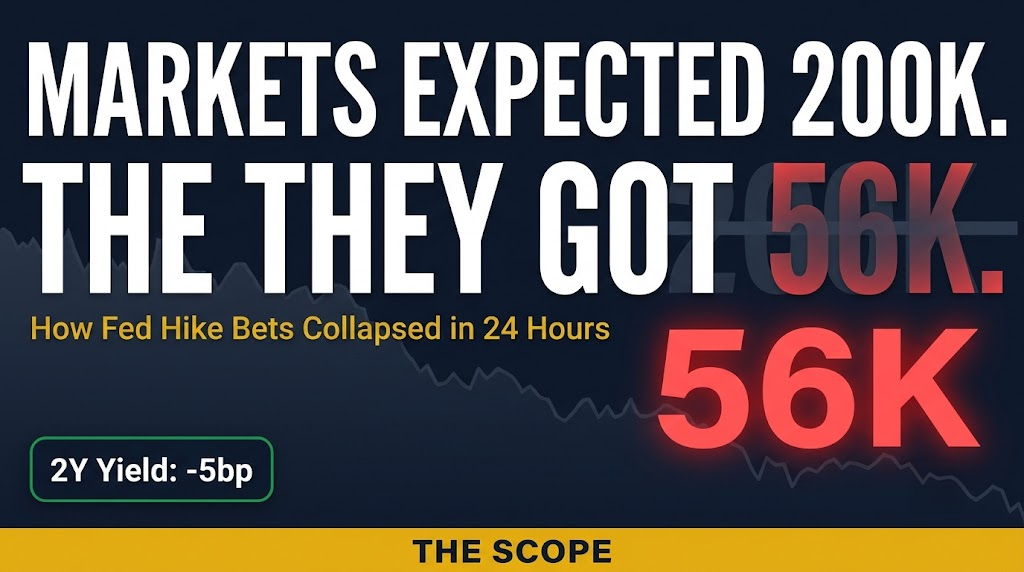
Markets Were Pricing a Rate Hike. Then June’s Jobs Number Came In at Half of Expectations.
Twenty-four hours earlier, traders had priced roughly even odds of a Fed hike by September. Then the headline payrolls number landed at less than half of what economists expected — and those bets unwound almost instantly.
The Hawkish Setup Going Into the Report
The day before June’s jobs report, the market mood was leaning distinctly toward tightening, not easing. Speaking at a European Central Bank forum, Fed Chair Kevin Warsh expressed optimism that the Fed’s 2% inflation target remains achievable, while simultaneously reaffirming that the central bank would not tolerate inflation running persistently above that level. The 10-year Treasury yield climbed as high as 4.50% on those comments. Warsh also reaffirmed his intent to shrink the Fed’s balance sheet, noting that executing that runoff would take at least 18 weeks — language that signaled a tightening posture likely to persist for some time.
Other data released that same day was broadly firm as well. ADP private payrolls came in at 98,000, a modest miss versus expectations but still marking twelve consecutive months of job gains, while the ISM manufacturing index remained in expansion territory even as its pace of growth moderated. The 10-year yield pared some of its gain as markets digested these releases, settling around 4.47%. By the close of that session, markets were pricing roughly a 30% probability of a July hike and 50% for September — a higher probability than the 36% assigned to a September hold.
Rate Hike Odds Priced In the Day Before the Report
~30%
~50%
~36%
A Preview Built on World Cup Optimism
Heading into the release, previews from outlets including Bloomberg leaned optimistic rather than cautious. Consensus expectations centered on a robust 200,000 gain for June, well above the headline 115,000 estimate and up from May’s 172,000, with specific tailwinds cited: World Cup-related hiring boosting leisure and hospitality employment, and state and local government payrolls expected to post their strongest gain of the year on the back of infrastructure bill spending. Within the private sector, education and healthcare along with World Cup-adjacent industries were expected to lead, while professional services was flagged as a likely drag — headcount reductions tied to AI adoption were already producing a visible slowdown in hiring within that sector specifically.
One detail buried in that preview proved prescient in hindsight: unemployment among recent college graduates had been running persistently higher than other cohorts since the start of the year, and forecasters warned that the shock of the June job-search season could push that rate as high as 4.6% by the fourth quarter. Even as the headline outlook looked solid, cracks were already visible beneath the surface for a specific, entry-level segment of the labor market.
The Number That Actually Landed
The actual report undercut every part of that optimistic setup. Nonfarm payrolls rose by just 56,000 (private payrolls: 49,000), less than half the 114,000 consensus estimate. Compounding the miss, prior months were revised sharply lower: May was cut from 172,000 to 129,000, and April was revised down from 179,000 to 148,000 — a combined 74,000 fewer jobs than had previously been reported across those two months.
The unemployment rate ticked down to 4.2% against a 4.3% consensus, but that improvement deserves a caveat rather than unqualified celebration: the labor force participation rate fell from 61.8% to 61.5% over the same period, consistent with people exiting or pausing their job search rather than a genuine tightening of labor market slack. Average hourly earnings matched expectations exactly on both a year-over-year basis (3.5%) and month-over-month basis (0.3%), meaning wages offered no meaningful surprise in either direction.
June Jobs Report — Actual vs. Consensus
| Nonfarm payrolls | 56K actual / 114K consensus / 129K prior (revised down) |
| Private payrolls | 49K actual / 110K consensus / 97K prior (revised down) |
| Unemployment rate | 4.2% actual / 4.3% consensus / 4.3% prior |
| Avg. hourly earnings (YoY) | 3.5% actual / 3.5% consensus / 3.4% prior |
| Avg. hourly earnings (MoM) | 0.3% actual / 0.3% consensus / 0.3% prior |
| Labor force participation | 61.5% actual / 61.8% prior |
How Bond Markets Reacted
The reaction across Treasuries was immediate. The policy-sensitive 2-year yield fell more than 5 basis points to around 4.11–4.14%. The benchmark 10-year yield eased roughly 1 basis point to about 4.46–4.47%. Ian Lyngen, head of U.S. rates strategy at BMO Capital Markets, summarized the shift bluntly: this morning’s data makes it difficult to envision a path to a July hike even if upside inflation surprises still materialize, and the probability of a July move has declined sharply, consistent with a read that payrolls have made a summertime hike difficult to justify.
September hike odds also came under pressure. CME Group’s FedWatch tool showed futures still assigning some probability to an eventual October move, but a September hike was effectively priced out following the release. Seema Shah, chief global strategist at Principal Asset Management, offered a measured read: the payroll slowdown challenges the recently building narrative of renewed labor market strength, but importantly it reinforces the view that the Fed is under little pressure to tighten policy in the near term.
Treasury Yield Reaction to the Report
4.11% (−5bp)
4.47% (−1bp)
Not Panic — But Not Nothing, Either
Most professional commentary treated this as a sober recalibration rather than cause for alarm. Jeff Schulze, head of economic and market strategy at ClearBridge Investments, noted that while job growth slowed more than expected and prior gains were revised lower, this isn’t cause for alarm: the labor market has still added 376,000 jobs outside the healthcare sector in the first half of the year, a stark contrast to the -271,000 recorded for all of 2025. That framing endorses the view that the Fed retains considerable flexibility to focus on price stability as the economy absorbs the effects of this year’s energy price surge.
Eric Merlis, managing director and co-head of global markets at Citizens, struck a similarly balanced tone: June’s net job creation of 57,000 was weaker than expected, but this comes on the heels of three consecutive months of solid jobs growth, and the unemployment rate at 4.2% remains low by historical comparison. He added a note of caution, however — with participation weakening and hiring cooling, the Fed’s decision to hold last month looks less like a policy mistake and more like prudent patience, and markets are already repricing a lower likelihood of Fed tightening as the inflation debate continues.
Key Risks
- Two consecutive months of sizable downward revisions raise real questions about how much confidence to place in the recent narrative of labor market re-acceleration
- The unemployment rate’s improvement is partly an artifact of falling labor force participation, meaning the headline number may overstate the underlying strength of the labor market
- Unemployment among recent college graduates is expected to keep climbing toward 4.6% by year-end, signaling continued entry-level labor market strain even as headline figures stabilize
Why This Isn’t a Crisis Signal
- Job growth excluding healthcare reached 376,000 in the first half of the year, a sharp improvement over the -271,000 recorded for all of 2025
- Wage growth matched consensus exactly on both a monthly and annual basis, showing no sign of the wage-driven inflation pressure that would most concern the Fed
- With July hike odds effectively eliminated, the report removes near-term pressure on the Fed to tighten policy abruptly
What to Watch From Here
The question this report raises extends beyond a simple hike-or-hold binary. Warsh has repeatedly emphasized that he won’t offer any form of forward guidance and has explicitly declined to commit to a fixed policy path during his short tenure at the helm. That means markets shouldn’t over-extrapolate a single data point into a settled multi-month policy trajectory. Next month’s jobs report — confirming or reversing this weakness — will matter far more for gauging the actual policy path than this release in isolation. At the same time, if upcoming inflation data runs hotter than expected, the Fed retains room to pivot back toward a hawkish posture even with a softening labor market backdrop, a combination investors should keep in view rather than assuming one data series settles the debate.
✦ THE SCOPE — KEY TAKEAWAYS
- June nonfarm payrolls rose just 56,000, less than half the 114,000 consensus estimate, with April and May revised down a combined 74,000 jobs.
- The day before the report, Fed Chair Warsh reaffirmed a hawkish inflation stance and markets were pricing roughly 30% odds of a July hike and 50% for September.
- The unemployment rate improved to 4.2%, but largely reflects a decline in labor force participation from 61.8% to 61.5% rather than genuine labor market tightening.
- The 2-year Treasury yield fell 5 basis points to 4.11% and the 10-year fell to 4.47%, as July hike odds were effectively eliminated following the release.
- Economists broadly characterized the miss as a recalibration rather than a crisis, pointing to 376,000 jobs added outside healthcare in the first half of the year — a sharp contrast to 2025’s full-year decline of 271,000.
This content is produced by The Scope for informational purposes only and does not constitute investment advice. All investment decisions are the sole responsibility of the reader. The Scope accepts no legal liability for actions taken based on this analysis.