📋 Desk Briefing
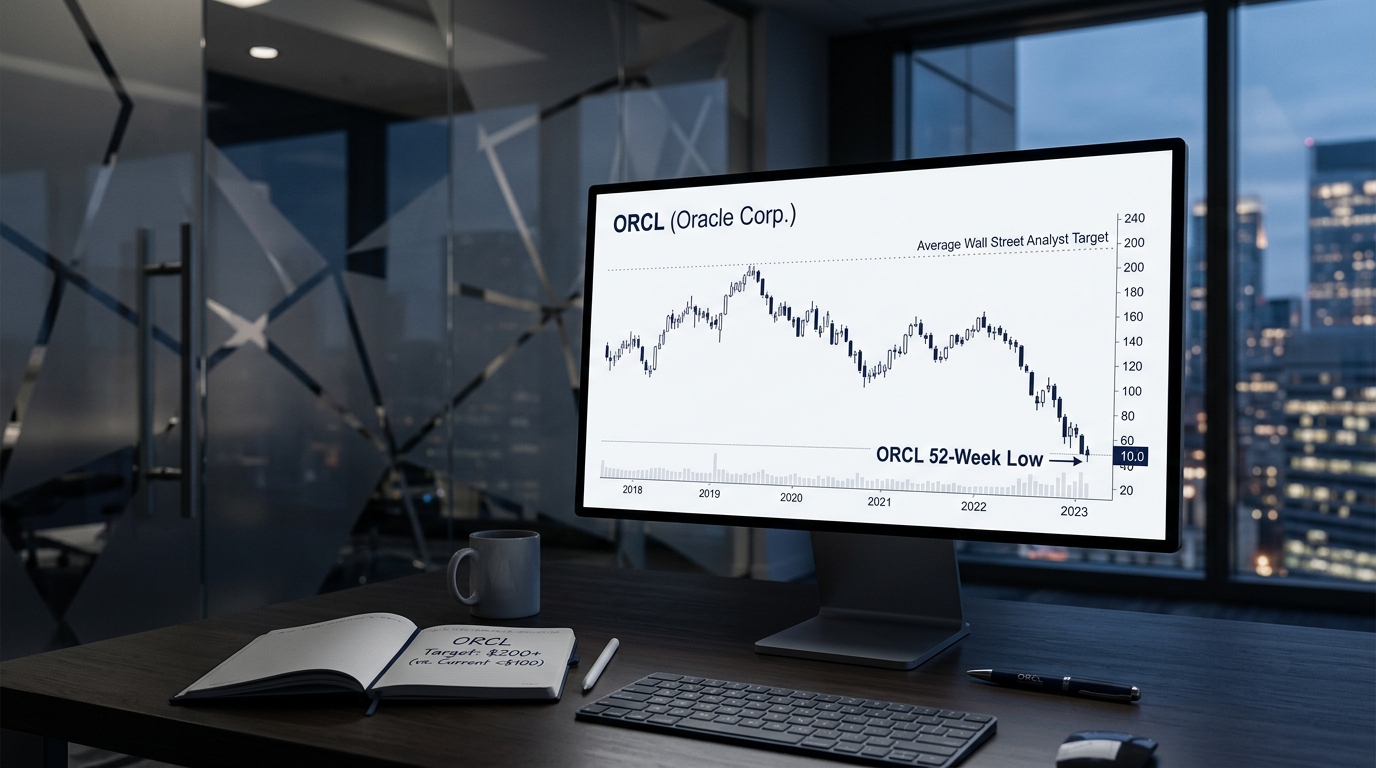
The market has punished Oracle (ORCL), sending its shares to a new 52-week low of roughly $115. Yet, the consensus on Wall Street tells a radically different story, with an average analyst price target sitting near $250 — more than double the current price. This chasm between market sentiment and analyst conviction presents the central question for investors: Is Oracle a deeply misunderstood AI infrastructure powerhouse on the verge of a massive re-rating, or a value trap buckling under the weight of its own ambition?
The pessimism stems from a brutal fiscal 2026 where capital expenditures soared to $55.7B to build out data centers for its booming cloud business. This spending binge consumed all of its record $32B in operating cash flow, resulting in a staggering negative free cash flow of -$23.7B. The spending spree triggered a credit downgrade from S&P Global to BBB-, just one notch above junk status, fueling fears about the company’s debt-fueled expansion.
However, the bull case is anchored by equally stunning numbers. The company’s Remaining Performance Obligations (RPO), a measure of contracted future revenue, has exploded to $638B. This colossal backlog is a direct result of massive demand for training AI large language models in the Oracle Cloud, highlighted by major deals with companies like OpenAI. The core debate is whether Oracle can convert this monumental backlog into profit before the costs of the build-out overwhelm its balance sheet.
📊 Earnings & Financials
Oracle’s fiscal Q4 2026 results showcased the dual narrative perfectly. Total quarterly revenues rose a robust 21% to $19.2B, beating estimates, while non-GAAP earnings per share came in at $2.11, also ahead of consensus. The engine of this growth is undeniably Oracle Cloud Infrastructure (OCI), which saw revenues rocket by 93% year-over-year. Total cloud revenue (IaaS and SaaS) for the quarter grew 47% to $9.9B, demonstrating a successful and accelerating transition away from its legacy on-premise software business.
For the full fiscal year 2026, the story was similar: total revenues grew 17% to a record $67.4B, and total cloud revenues jumped 39% to $34.0B. This performance is what underpins management’s confidence, with guidance for fiscal 2027 pointing to total revenue growth of around 34% to approximately $90B. Despite this top-line momentum, the market remains fixated on the costs. The -$23.7B in free cash flow for FY2026 is a jarring figure for a mature tech company, directly resulting from the massive capital investments needed to satisfy the AI-driven demand.
| Metric | Live Data (FY 2026) | Strategic Read |
|---|---|---|
| Total Revenue | $67.4B (+17% YoY) | Strong top-line growth validating the strategic pivot to cloud. |
| Total Cloud Revenue (IaaS + SaaS) | $34.0B (+39% YoY) | Cloud is now the primary growth driver, comprising over half of total revenue. |
| Cloud Infrastructure (IaaS) Revenue | $18.1B (+77% YoY) | Explosive growth confirms OCI is winning significant AI and enterprise workloads. |
| Non-GAAP EPS | $7.63 (+27% YoY) | Profitability remains strong despite heavy investment, a key bull argument. |
| Operating Cash Flow | $32.0B (+54% YoY) | Record cash generation shows the underlying health of the business. |
| Free Cash Flow | -$23.7B | The core of the bear thesis; capex is temporarily overwhelming cash flow. |
| Remaining Performance Obligations | $638B | A massive backlog that provides significant future revenue visibility. |
🔍 Deep Dive: Competitive Moat
Oracle’s long-term investment case hinges on the durability of its competitive advantages in a fiercely contested market. For decades, its moat was its dominant, sticky on-premise database business. Now, as the tech landscape shifts, Oracle is forging a new, multi-faceted moat built on specialized cloud infrastructure, deep enterprise application integration, and a strategic hold on mission-critical data.
The centerpiece of the modern strategy is Oracle Cloud Infrastructure (OCI). Rather than competing head-on with hyperscalers like Amazon Web Services (AWS), Microsoft Azure, and Google Cloud Platform (GCP) across every generic service, Oracle has carved out a niche in high-performance computing. OCI’s architecture is differentiated by its high-speed, low-latency RDMA cluster networking, which is particularly well-suited for the demanding workloads of AI model training and large-scale database operations. This technological edge is a key reason it has won significant contracts from AI leaders, validating its performance claims. Furthermore, Oracle is pursuing a multicloud strategy, establishing direct interconnects with Microsoft Azure and Google Cloud, allowing customers to run their applications on other clouds while using Oracle’s databases on OCI, a pragmatic approach that meets customers where they are.
The second pillar of its moat is the integration between its infrastructure and its vast suite of enterprise applications. Oracle is a leader in Enterprise Resource Planning (ERP), Human Capital Management (HCM), and Supply Chain Management (SCM) software. By offering both the application (SaaS) and the underlying infrastructure (IaaS), Oracle can deliver better performance, security, and lower total cost of ownership for its customers. This creates a powerful flywheel: a customer using Oracle Fusion ERP on OCI is highly unlikely to migrate either component separately, deepening the customer relationship and creating high switching costs.
Finally, the controversial $28B acquisition of Cerner, now Oracle Health, represents a bold, long-term bet on vertical integration in the massive healthcare sector. While the integration has been challenging, with reports of customer attrition and declining market share against competitor Epic, the strategic intent is clear. Oracle aims to create a unified national health records database, leveraging its cloud and AI capabilities to modernize a fragmented and inefficient industry. If successful, Oracle Health could become an unassailable moat, embedding Oracle’s technology at the core of healthcare delivery. However, execution risk remains high, and the division has yet to prove it can reverse its market share losses.
💡 Investment Scenarios
The bull case rests on the idea that the market is overly focused on short-term cash burn and is ignoring the enormous, contracted revenue backlog. Bulls argue that the $638B in RPO is a clear indicator of massive, locked-in future growth. They believe the heavy capex of FY2026 is a temporary investment phase that will soon translate into a torrent of high-margin revenue as OCI capacity comes online. With OCI growing at over 90% and a forward P/E ratio under 15, bulls see a severe valuation mismatch for a company at the heart of the AI revolution. The bet is that Oracle successfully converts its AI contracts into cash flow, normalizes spending, and commands a much higher multiple as the market recognizes its position as a key AI infrastructure player.
The bear case is centered on financial risk and competitive pressure. Bears point to the -$23.7B in negative free cash flow, the S&P credit downgrade to near-junk status, and the need to raise billions in new debt and equity as signs of a company overextending itself. They worry that the cost of competing with entrenched, cash-rich hyperscalers like Amazon and Microsoft is simply too high. There are also concerns about customer concentration, with a significant portion of the AI backlog reportedly tied to a few key customers like OpenAI. Furthermore, bears highlight the struggles in the Oracle Health division, where the Cerner acquisition has led to market share loss, suggesting Oracle may be facing significant execution challenges in its ambitious healthcare vertical play.
⚡ Bottom Line
Oracle presents a classic battleground stock. The enormous gap between its 52-week low and Wall Street’s price targets reflects deep division over its future. For investors, the decision boils down to time horizon and risk tolerance: a belief in the long-term conversion of its massive AI backlog into cash flow versus the very real short-term risks of heavy debt and intense competition.
This content is for informational purposes only and does not constitute investment advice. Investment decisions are the reader’s own responsibility. The Scope assumes no legal liability for outcomes.