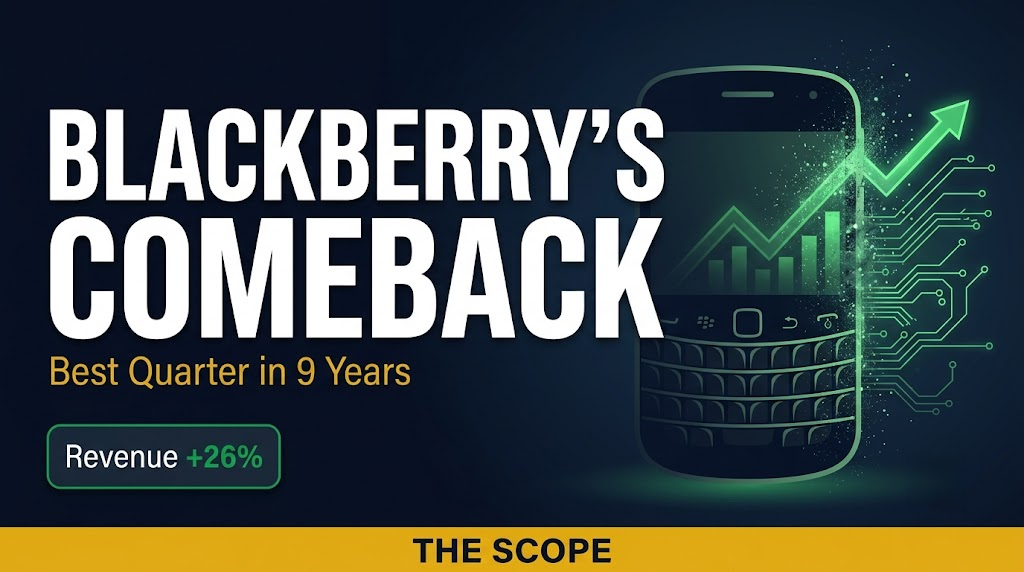
BlackBerry Isn’t a Nostalgia Stock Anymore — It Just Posted Its Best Quarter in Nine Years
The smartphone maker everyone wrote off has quietly rebuilt itself into a profitable software company — and Wall Street is only now starting to notice.
The Quarter That Changed the Narrative
For most investors, BlackBerry stopped mattering around 2016, when the last physical keyboard phone rolled off the production line. The company became a punchline — the cautionary tale of a once-dominant tech brand that failed to adapt to the smartphone era. That narrative is now badly out of date, and the company’s first quarter of fiscal year 2027 makes the case more clearly than any turnaround story has in years.
BlackBerry reported revenue of $152.9 million, up 26% year-over-year and roughly 11% ahead of Wall Street’s consensus estimate. Adjusted EBITDA grew 144% over the same period. GAAP operating income came in at $15.3 million. And perhaps most tellingly, the company posted its first cash-positive fiscal first quarter in nine years, with management now guiding toward approximately $100 million in positive operating cash flow for the full fiscal year.
The market’s reaction was immediate and dramatic. Shares jumped nearly 20% the day the results were announced, climbing from $8.62 to $10.34. The momentum has continued since — by late June, BlackBerry stock had pushed above $12, representing roughly a 47% move in under two weeks and more than 130% year-to-date.
BlackBerry Stock Price — June 2026 Surge
BB jumped nearly 20% on Q1 FY27 earnings day and has continued climbing on analyst upgrades and partnership news.
Two Businesses Doing the Heavy Lifting
The transformation story rests on two segments most casual observers have never heard of: QNX and Secure Communications. Both achieved what’s known in software circles as the “Rule of 40” this quarter — a benchmark where a company’s growth rate plus profit margin exceeds 40%, widely considered the gold standard for healthy SaaS-style businesses.
QNX is BlackBerry’s embedded operating system, the software running inside millions of cars, medical devices, and industrial robots that need real-time, safety-certified reliability. As the industry races to build what’s increasingly called “physical AI” — AI systems controlling real-world machinery rather than just generating text — QNX’s positioning as the safety-certified backbone for that hardware has become unexpectedly valuable. New robotics demonstrations and chipmaker partnerships have reinforced this narrative throughout 2026.
Secure Communications, BlackBerry’s other core engine, maintains something few competitors can claim: its AtHoc platform holds FedRAMP Class D (High) certification, making it the only critical event management cloud platform certified at the U.S. government’s highest security tier. That moat has proven durable even as cybersecurity competition has intensified industry-wide.
Wall Street’s Reaction — Price Target Hikes
| Stifel | New coverage, Buy, $12 target — calls BB a “physical AI” software partner |
| CIBC | Outperform maintained, target raised from $8.50 to $10 |
| Canaccord | Hold, target raised from $4.40 to $8.20 |
The Valuation Problem Nobody Can Ignore
Here is where the bullish story runs into a hard wall of math. Even after Stifel’s bullish new $12 target, BlackBerry stock was already trading at $12.36 by June 29 — meaning the stock has outrun even the most optimistic analyst on Wall Street. A broader survey of seven analysts shows a Hold consensus with an average price target closer to $7.90, dramatically below where the stock currently sits.
This is the central tension every investor needs to weigh. The fundamental turnaround is real — the Rule of 40 performance, the nine-year cash flow milestone, and the FedRAMP-certified moat are not manufactured numbers. But the stock price has already moved so far, so fast, that it is pricing in a level of sustained execution that BlackBerry has not yet proven it can deliver across multiple quarters, not just one standout print.
Key Risks
- Stock has already surpassed most analyst price targets, leaving limited room for further upside without continued earnings beats
- A single strong quarter does not yet confirm a durable, multi-year growth trajectory
- Secure Communications growth is expected by some analysts to slow to low-single-digit rates longer term
Why the Bulls Have a Case
- Both core segments hit Rule of 40 simultaneously — a genuine signal of operating health, not a one-off accounting gain
- QNX’s position in the “physical AI” robotics and automotive trend is a structural tailwind, not a fad
- Management’s renewed share buyback authorization signals internal conviction that shares remain undervalued even after the rally
✦ THE SCOPE — KEY TAKEAWAYS
- BlackBerry posted Q1 FY27 revenue of $152.9 million, up 26% year-over-year, beating consensus estimates by roughly 11%.
- Adjusted EBITDA grew 144%, and the company achieved its first cash-positive fiscal first quarter in nine years.
- Both QNX and Secure Communications hit the Rule of 40 benchmark, signaling genuine operating health rather than a one-time accounting boost.
- The stock has surged over 130% year-to-date and now trades above even the most bullish analyst price target on Wall Street.
- The investment debate has shifted from “is BlackBerry still relevant” to “has the stock already priced in more good news than the company has proven it can deliver.”
This content is produced by The Scope for informational purposes only and does not constitute investment advice. All investment decisions are the sole responsibility of the reader. The Scope accepts no legal liability for actions taken based on this analysis.