🔋 ESS BATTERY SERIES — PART 1 OF 4
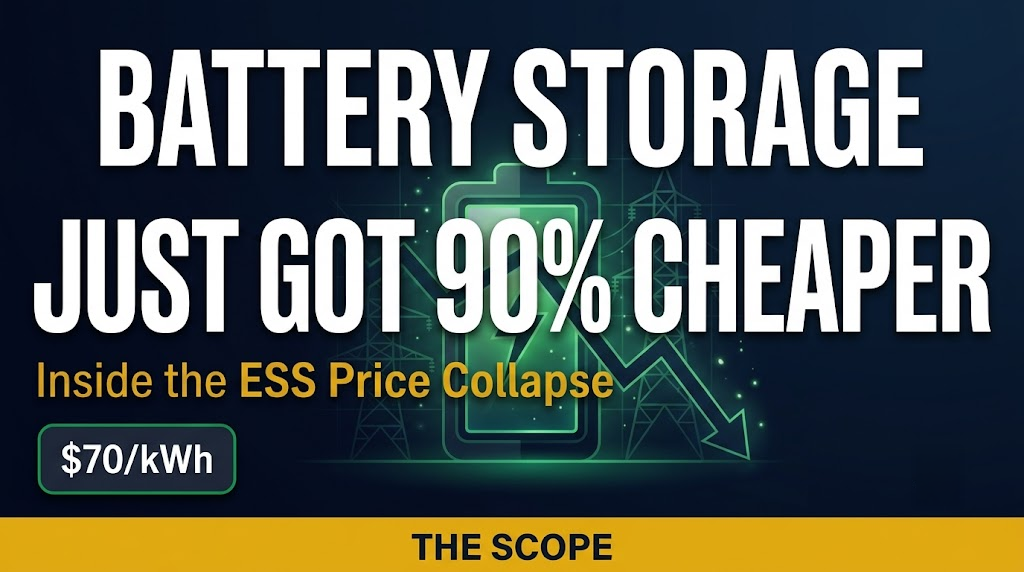
Battery Storage Just Got 90% Cheaper Than 2010 — And That Changes Everything About the Power Grid
Stationary battery storage became the cheapest segment of the entire battery market in 2025. The economics of energy storage have crossed a threshold most investors haven’t priced in yet.
A Number Worth Sitting With
In 2010, a kilowatt-hour of lithium-ion battery storage cost more than $1,200. By 2025, that figure had collapsed to roughly $139 on average — and within the stationary storage segment specifically, average pack prices fell to just $70 per kilowatt-hour, a 45% single-year decline that made battery energy storage systems (BESS) the cheapest segment in the entire battery market for the first time, according to BloombergNEF’s 2025 survey. The lowest observed cell and pack prices for lithium iron phosphate (LFP) batteries going into stationary storage hit $36 and $50 per kilowatt-hour respectively — and these aren’t outlier flukes. Similar lows were observed the year before, confirming this is now a stable price floor, not a temporary anomaly.
This collapse matters because energy storage economics determine whether grid-scale renewable energy actually works at scale. Solar and wind generate power intermittently; storage is what makes that power dispatchable on demand. When storage costs fall this fast, the entire calculus of replacing fossil fuel peaker plants with battery arrays shifts dramatically in storage’s favor.
Stationary Storage Pack Prices — The Collapse
Stationary storage pack prices fell 45% in a single year, becoming the cheapest segment across the entire battery market for the first time on record.
Why LFP Won — and Won Decisively
The driving force behind this collapse has a name: lithium iron phosphate, or LFP. Unlike nickel manganese cobalt (NMC) chemistry, LFP requires no nickel and no cobalt — both volatile, geopolitically exposed commodities. That structural cost advantage, combined with longer cycle life (3,000 to 6,000 cycles versus shorter NMC lifespans) and superior thermal stability, has made LFP the default chemistry for stationary storage, now accounting for over 90% of global battery energy storage system deployments.
The price gap is substantial: LFP battery packs were on average more than 40% cheaper than NMC alternatives in 2025. And critically, this cost advantage proved resilient even when raw material prices spiked. When cobalt prices jumped sharply after the Democratic Republic of Congo introduced export quotas, and lithium prices rose alongside it, overall battery prices kept falling anyway — the industry absorbed those shocks through deeper LFP adoption, long-term supply contracts, and hedging strategies that simply weren’t available a few years earlier.
LFP vs. NMC — The Cost Gap
| LFP average pack price (2025) | $81/kWh |
| NMC average pack price (2025) | $128/kWh |
| Cost advantage | 37% cheaper |
Battery Pack Prices by Region (2025)
$84/kWh
$121/kWh
$131/kWh
China’s prices were roughly 30% lower than North America and 35% lower than Europe in 2025 — a gap that has widened steadily since 2022, reflecting deeper supply chain integration and manufacturing scale.
Price by Battery Application — Stationary Storage Now Cheapest
EV
Vehicles
Avg.
Storage
For the first time on record, stationary storage is the cheapest application across the entire battery market — roughly half the price of the all-segment average.
The Uncomfortable Question Behind These Prices
A price collapse this steep raises an obvious question: is this sustainable, or is the industry simply burning cash to win market share? The evidence points toward genuine structural cost advantage rather than pure subsidy. LFP’s lack of cobalt and nickel dependency is a real, durable materials-cost advantage, not an accounting trick. But there is a real concern layered underneath: many cathode active material producers in China are currently operating at a loss while continuing to expand capacity, which increases the risk of industry consolidation. If producers eventually regain pricing power after a wave of consolidation, that could put upward pressure on prices from today’s record lows.
China’s overcapacity is the other half of this story. China has consistently produced far more battery cells than its domestic EV and storage demand requires, creating intense price competition among manufacturers — competition that’s been most pronounced specifically in the stationary storage segment, where many suppliers can serve the same utility-scale projects. That overcapacity dynamic, more than any single technology breakthrough, explains why prices have fallen faster in stationary storage than in any other battery segment.
What Could Reverse the Price Trend
- Industry consolidation among loss-making Chinese cathode producers could eventually restore pricing power and push costs back up
- Sustained elevation in lithium, cobalt, or nickel prices would eventually pressure manufacturer margins if absorption strategies reach their limits
- Lithium carbonate spot prices have already risen roughly 264% off their mid-2025 low, a trend BESS market participants are still learning to hedge against
✦ THE SCOPE — KEY TAKEAWAYS
- Stationary battery storage pack prices fell 45% in 2025 alone, reaching $70/kWh and becoming the cheapest segment in the entire battery market for the first time on record.
- LFP chemistry, which eliminates costly nickel and cobalt, now accounts for over 90% of global battery energy storage deployments and remains roughly 37% cheaper than NMC alternatives.
- Chinese cell manufacturing overcapacity is the primary structural driver of falling prices, particularly in stationary storage where many suppliers compete for the same utility-scale projects.
- A real risk underlies these record-low prices: many Chinese cathode producers are operating at a loss, raising the possibility of future consolidation and price recovery.
- The next installment in this series examines why LFP dominates today’s market and whether emerging chemistries like sodium-ion pose a genuine competitive threat.
This content is produced by The Scope for informational purposes only and does not constitute investment advice. All investment decisions are the sole responsibility of the reader. The Scope accepts no legal liability for actions taken based on this analysis.