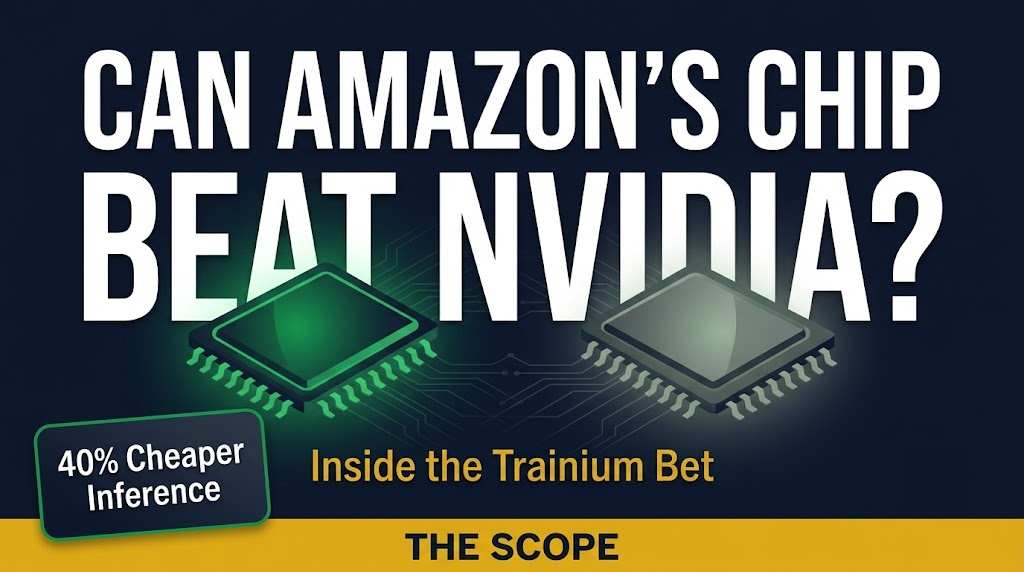
Can Amazon’s Own AI Chips Actually Challenge NVIDIA — Or Are They Just a Cost-Cutting Trick?
Trainium isn’t trying to beat NVIDIA at its own game. It’s trying to make NVIDIA’s monopoly pricing power irrelevant — and that’s a very different kind of threat.
The Question Every Investor Should Be Asking
Every hyperscaler now claims to be building its own AI chips. Google has TPUs. Microsoft has Maia. Meta has its own custom silicon. Amazon has Trainium. The natural investor question is whether any of this represents real technological competition with NVIDIA, or whether it’s simply a negotiating tactic — a way to extract better pricing from NVIDIA by threatening to walk away.
For Amazon specifically, the answer is more interesting than either extreme. Trainium is not designed to outperform NVIDIA’s most advanced GPUs on raw computational power. It is designed to make the economics of AI inference dramatically better for a specific, enormous category of workload — and that distinction matters more than most coverage acknowledges.
Training vs. Inference: The Distinction That Changes Everything
To understand Trainium’s actual competitive position, you need to separate two very different AI workloads. Training a frontier model — the process of teaching a model like Claude or GPT from scratch — requires the absolute cutting edge of computational power, and NVIDIA’s H100 and B200 GPUs remain the default choice for nearly every lab attempting it.
Inference — the process of actually running a trained model to answer a question, generate an image, or power an AI agent — is a fundamentally different problem. It happens at far larger scale, far more frequently, and the margin pressure is brutal. Every major AI company now runs orders of magnitude more inference than training. This is where Trainium’s design philosophy becomes genuinely compelling: it is purpose-built to make inference radically cheaper, even if it can’t match NVIDIA’s flagship chips on training benchmarks.
Cost Per Inference Token — Trainium vs NVIDIA H100
$1.00
$0.74
$0.61
Illustrative cost-per-token estimates based on AWS pricing disclosures and third-party benchmarking. Actual savings vary by workload type and model architecture.
The Anthropic Proof Point: Project Rainier
The strongest evidence that Trainium is more than a bargaining chip is Anthropic’s decision to build Project Rainier — a massive Trainium-based compute cluster — as a core part of its training and inference infrastructure. Anthropic, the company behind Claude, has access to NVIDIA’s best chips through multiple cloud partnerships. Its choice to commit serious infrastructure investment to Trainium is not something a company does to satisfy a contractual obligation. It’s something a company does because the chip works for its specific economics.
This matters because Anthropic has every incentive to use whatever hardware produces the best Claude performance per dollar. If Trainium were simply a cost-cutting gimmick with mediocre real-world performance, it would show up in degraded model quality or higher latency — and Anthropic would have no reason to scale its commitment. Instead, the relationship has deepened, with Amazon’s $13 billion equity investment in Anthropic running in parallel with expanded Trainium usage.
Why NVIDIA Isn’t Actually Threatened — Yet
It would be a mistake to read Trainium’s progress as an imminent threat to NVIDIA’s dominance. NVIDIA still controls roughly 80% of the global AI accelerator market, and its CUDA software ecosystem represents a moat that custom silicon makers have struggled to replicate for over a decade. Switching an AI workload from NVIDIA’s stack to a custom chip requires significant engineering investment that most companies — outside of hyperscalers with the resources to do it — simply cannot justify.
What Trainium does change is NVIDIA’s pricing leverage at the margin. Every dollar that Amazon successfully shifts from NVIDIA GPUs to in-house silicon is a dollar where NVIDIA’s near-monopoly pricing power doesn’t apply. As Trainium captures a larger share of Amazon’s own inference workloads — both for internal use and through AWS customers — it creates a structural ceiling on how aggressively NVIDIA can price its chips for Amazon’s business specifically.
Trainium’s Real Strategic Function
| Not this | Outperforming NVIDIA’s flagship training chips |
| Actually this | Lowering inference costs at scale, capturing margin NVIDIA would otherwise take |
| Bonus effect | Negotiating leverage on NVIDIA pricing for Amazon’s remaining GPU purchases |
The Third-Party Sales Question
The more ambitious version of Amazon’s chip strategy involves selling Trainium capacity to external customers through AWS, not just using it internally. This is structurally similar to Google’s approach with TPUs, which Google has increasingly opened up to outside customers beyond its own DeepMind and Gemini workloads.
If Amazon can convince a meaningful number of AI companies to run inference workloads on Trainium instead of renting NVIDIA GPU capacity through AWS, the economics shift in Amazon’s favor twice over: AWS captures the infrastructure margin, and Amazon’s own chip division benefits from the volume needed to keep improving Trainium’s price-performance with each generation. The flywheel only works, however, if enough external customers trust the chip enough to build production workloads on it — and that trust is still being established generation by generation.
What Could Limit Trainium’s Upside
- NVIDIA’s CUDA ecosystem lock-in remains a powerful switching cost for most AI developers
- Third-party adoption of Trainium for external workloads is still in early stages compared to Google’s more mature TPU external program
- NVIDIA continues to innovate aggressively, meaning the cost gap could narrow with each new GPU generation
Why the Bet Still Makes Sense
- Anthropic’s growing commitment to Project Rainier is real-world validation, not just a contractual checkbox
- Inference workloads — where Trainium’s economics shine — are growing far faster than training workloads industry-wide
- Even partial success in shifting inference away from NVIDIA improves Amazon’s AI gross margins meaningfully at AWS’s scale
✦ THE SCOPE — KEY TAKEAWAYS
- Trainium is not designed to beat NVIDIA’s most advanced chips on raw training performance — it’s designed to make AI inference dramatically cheaper at scale.
- Anthropic’s expanding commitment to Trainium through Project Rainier is the strongest evidence that the chip delivers real, not just contractual, value.
- NVIDIA’s roughly 80% market share and CUDA ecosystem moat remain intact in the near term — Trainium’s threat is at the margin, not a direct takeover.
- The bigger long-term opportunity is third-party Trainium adoption through AWS, following the model Google has used with external TPU sales.
- Even modest success shifting inference workloads away from NVIDIA improves Amazon’s AI economics meaningfully given AWS’s scale.
This content is produced by The Scope for informational purposes only and does not constitute investment advice. All investment decisions are the sole responsibility of the reader. The Scope accepts no legal liability for actions taken based on this analysis.