🔋 ESS BATTERY SERIES — PART 2 OF 4
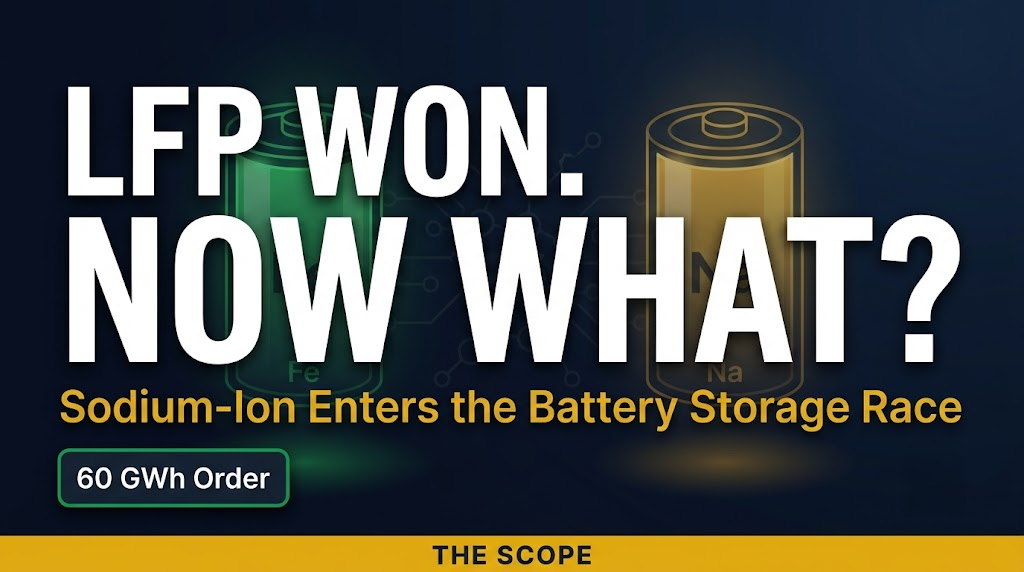
LFP Already Won the Battery Storage War — Now Sodium-Ion Wants a Rematch
One chemistry conquered grid-scale storage by eliminating expensive metals entirely. A second, even cheaper chemistry is now entering commercial deployment — and a third is being widely misunderstood by investors.
Why One Chemistry Dominates Everything
Walk into any large-scale battery storage facility built in the past two years, and the odds are overwhelming that it runs on lithium iron phosphate (LFP) cells. The chemistry now accounts for more than 90% of global battery energy storage system deployments — a level of dominance unusual in any technology market, let alone one as capital-intensive as grid infrastructure.
The reason is structural, not fashionable. LFP requires no nickel and no cobalt, the two commodities responsible for most of the price volatility and geopolitical risk in battery manufacturing. What it trades away — lower energy density, meaning more physical space required to store the same amount of energy — simply doesn’t matter for stationary storage the way it does for electric vehicles, where every kilogram of weight affects range. A shipping container of batteries sitting next to a solar farm doesn’t care how much it weighs.
Global ESS Chemistry Market Share
LFP (Lithium Iron Phosphate)
NMC, sodium-ion & other chemistries
The Challenger: Sodium-Ion Moves From Lab to Grid
If LFP’s advantage is no nickel or cobalt, sodium-ion’s pitch is more radical still: no lithium at all. Sodium is roughly 1,000 times more abundant in the earth’s crust than lithium and doesn’t carry the geographic concentration risk that has made lithium supply chains a geopolitical flashpoint. For years, sodium-ion remained a promising but commercially immature technology. That changed decisively in 2026.
CATL, the world’s largest battery manufacturer, unveiled what it calls the world’s first platform-based sodium-ion battery designed specifically for energy storage at the ESIE 2026 conference in Beijing, with commercial deployment expected within the year. The cell is built on a 300+ Ah large-format design with 97% system energy conversion efficiency and a cycle life exceeding 15,000 cycles at 80% capacity retention — figures that meaningfully exceed typical LFP cycle life specifications. Critically, CATL designed the cell with the same enclosure dimensions as its existing 587 Ah lithium storage platform, deliberately minimizing the switching costs for customers who want to adopt the new chemistry without redesigning their systems.
CATL’s Sodium-Ion ESS Cell — Key Specs
| Cycle life | 15,000+ cycles @ 80% retention |
| System efficiency | 97% |
| Operating temperature | -40°C to 70°C |
| Format | 300+ Ah, compatible with existing 587 Ah lithium enclosures |
Cycle Life Comparison — Sodium-Ion vs. LFP
(upper range)
ESS Cell
CATL’s new sodium-ion ESS cell claims cycle life more than double typical LFP specifications — a meaningful advantage for long-duration grid storage economics.
The Order Book Tells the Real Story
Specifications matter less than orders, and the order book for sodium-ion has moved decisively in 2026. CATL secured what it describes as the world’s largest sodium-ion battery order to date — a 60 gigawatt-hour deal with Chinese storage integrator HyperStrong, building on an existing 200 GWh battery supply framework agreement spanning 2026 to 2028. The International Renewable Energy Agency (IRENA) has projected that sodium-ion cell costs could eventually fall to $40 per kilowatt-hour — below even today’s record-low LFP cell prices — though IRENA also cautioned that sodium-ion will likely supplement rather than fully replace lithium-based chemistries, with future deployment scale still uncertain.
CATL’s own framing is instructive: the company describes its strategy as a “dual-star” approach, developing sodium-ion and lithium-ion in parallel rather than betting everything on one chemistry replacing the other. That’s a meaningfully different signal than a company abandoning one technology for another — it suggests sodium-ion is being positioned as a hedge against lithium price volatility and supply concentration, available for deployment when economics favor it, rather than a wholesale replacement.
Sodium-Ion Commercialization Timeline (2026)
CATL and Changan unveil world’s first mass-produced sodium-ion passenger EV
CATL unveils first platform-based sodium-ion battery built specifically for energy storage
CATL secures 60 GWh sodium-ion order with HyperStrong, the largest in industry history
CATL confirms manufacturing bottlenecks resolved, full-scale mass production underway
The Most Misunderstood Chemistry: Why Solid-State Isn’t an ESS Story
Solid-state batteries generate enormous investor enthusiasm, but applying that excitement to grid-scale storage reflects a category error. Solid-state technology’s core value proposition — dramatically higher energy density and faster charging, achieved by replacing liquid electrolyte with a solid one — solves problems that matter intensely for electric vehicles and consumer electronics, where space and weight are at a premium. Stationary storage installations face no such constraint; a battery container can simply be larger.
What stationary storage actually needs is cost per kilowatt-hour and cycle life at scale — and solid-state technology, at least in its current developmental stage, remains significantly more expensive to manufacture than LFP or sodium-ion, with production scaling challenges still unresolved years into development. CATL itself, while aggressively commercializing sodium-ion for storage in 2026, has positioned solid-state development around what it calls “rewriting the performance ceiling” — explicitly framing it as a technology aimed at performance-constrained applications, not the cost-driven grid storage market. Investors chasing solid-state exposure as an ESS theme are very likely chasing the wrong application of the right technology.
Three Chemistries, Three Different Jobs
| Chemistry | Best Suited For | ESS Relevance |
|---|---|---|
| LFP | Cost-driven, space-flexible applications | Dominant (90%+) |
| Sodium-Ion | Lithium-free hedge, cold climates, long cycle life | Rapidly emerging |
| Solid-State | Energy density / weight-constrained applications (EVs) | Minimal near-term fit |
What Could Slow Sodium-Ion’s Rise
- IRENA cautions that future deployment scale remains genuinely uncertain, with demand and supply chain robustness still developing
- LFP’s continued price declines could narrow or eliminate sodium-ion’s cost advantage before it achieves meaningful market share
- CATL’s “dual-star” framing itself suggests sodium-ion is being positioned as a complement rather than a wholesale lithium replacement, capping its addressable market by design
✦ THE SCOPE — KEY TAKEAWAYS
- LFP’s elimination of nickel and cobalt has made it the dominant chemistry in over 90% of global battery energy storage deployments.
- CATL’s new sodium-ion ESS cell offers cycle life exceeding 15,000 cycles — more than double typical LFP specifications — and entered commercial deployment in 2026.
- A 60 GWh sodium-ion order with HyperStrong, the largest in industry history, signals sodium-ion has moved decisively from lab demonstration to commercial-scale deployment.
- Solid-state battery technology is largely irrelevant to grid-scale storage economics — its energy density advantages solve EV-specific constraints that stationary storage doesn’t face.
- The next installment in this series examines how geopolitics — Chinese export restrictions, U.S. tariffs, and trade policy — is reshaping which countries can actually compete in battery manufacturing.
This content is produced by The Scope for informational purposes only and does not constitute investment advice. All investment decisions are the sole responsibility of the reader. The Scope accepts no legal liability for actions taken based on this analysis.