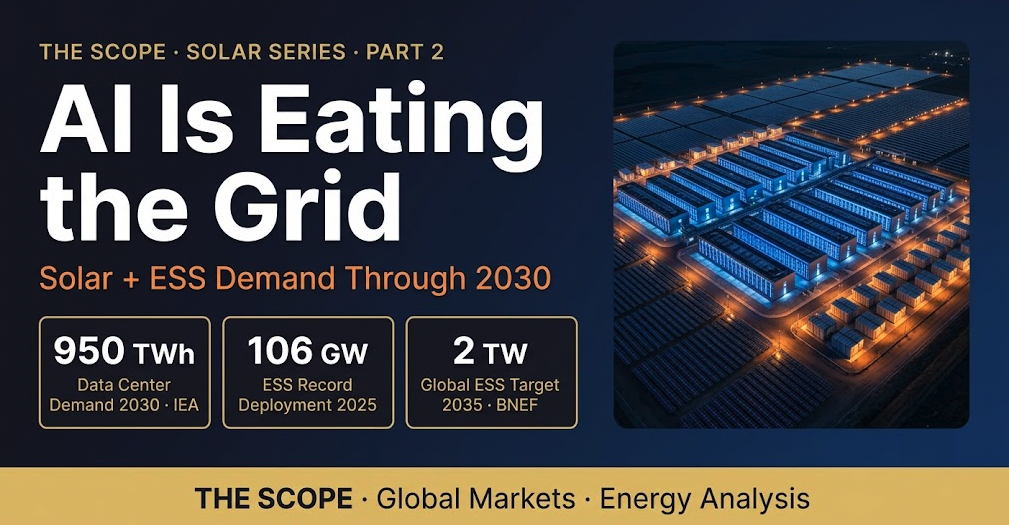
DATA CENTER DEMAND 2030
950 TWh
IEA Base Case · 2× from 2025
ESS DEPLOYMENT 2025
106 GW
Global record · Wood Mackenzie
ESS MARKET 2035
$423B
Solar + storage · CAGR 17.4%
The Electricity Problem Nobody Saw Coming
For two decades, US electricity consumption was essentially flat. Efficiency gains in appliances, lighting, and industrial processes offset the growth in demand. Grid operators planned for stability. Utilities modeled slow, predictable growth. Then AI arrived — and the math changed overnight.
The IEA’s most recent projections tell a story that should alarm anyone thinking about energy infrastructure. Global electricity consumption from data centers is set to roughly double from 485 TWh in 2025 to around 950 TWh by 2030. AI-specific demand is growing even faster — tripling over the same period. In the United States alone, data centers are expected to account for nearly half of all electricity demand growth between now and 2030. By the end of the decade, American data centers will consume more power than the country’s entire aluminum, steel, cement, and chemical industries combined.
To put 950 TWh in physical terms: that is slightly more than Japan’s entire electricity consumption today. A country of 125 million people, with one of the world’s most industrialized economies, is essentially being added to global electricity demand — purely from servers running AI workloads. And this is the base case. The IEA’s upside scenario is considerably higher.
Why Solar Is the Default Answer — And Why It’s Not Enough Alone
When a hyperscaler needs to power a new data center campus, the economics of energy sourcing have fundamentally shifted. A decade ago, the cheapest option was almost always grid power — fossil fuel generation at scale, delivered through existing transmission infrastructure. Today, in most regions of the world, solar combined with battery storage is the cheapest new source of electricity generation. That reversal is structural, not cyclical.
Microsoft, Google, Amazon, and Meta have collectively committed to hundreds of gigawatts of renewable energy through Power Purchase Agreements (PPAs). These are long-term contracts — typically 15 to 25 years — where a tech company agrees to buy electricity from a specific renewable energy project at a fixed price. The arrangement gives the developer the revenue certainty to secure financing; the tech company gets a hedge against electricity price volatility and a credible path toward its carbon commitments.
But solar PPAs alone have a fundamental problem: the sun does not shine at night, and data centers run 24 hours a day. A data center drawing 500 megawatts of continuous power cannot simply turn off its servers when the sun sets. This is the problem that has made the solar-plus-storage combination — not solar alone — the defining infrastructure investment of this decade.
THE PROBLEM
Solar Alone
- Only generates during daylight hours (~6–8 hours at peak)
- Data centers need 24/7 baseload power
- Creates “duck curve” grid stress at sunset
THE SOLUTION
Solar + ESS
- Battery stores daytime solar for evening/night dispatch
- LFP batteries now dominant — safer, longer cycle life
- Co-location becoming mainstream in US and Europe
The ESS Boom: Numbers That Define a Structural Shift
The energy storage market is no longer a niche technology story. In 2025, global energy storage deployment hit a record 106 GW — a 23% increase over 2024. The United States alone added a record 57.6 GWh of battery storage capacity in 2025, with utility-scale projects in California, Texas, and Arizona leading the way. In Q1 2026, the US installed 9.7 GWh in a single quarter — the strongest first quarter in the industry’s history.
BloombergNEF’s projections extend the trajectory: cumulative global energy storage capacity is expected to reach 2 terawatts by 2035 — eight times the level in 2025. The solar energy storage market, valued at $86.8 billion in 2025, is projected to reach $423 billion by 2035 at a compound annual growth rate of 17.4%. These are not optimistic scenarios — they are base-case projections from the industry’s most rigorous forecasting bodies.
The technology mix is also shifting. Lithium iron phosphate (LFP) batteries have come to dominate the market over the last three to four years, displacing earlier nickel-manganese-cobalt (NMC) chemistries. LFP offers lower energy density but dramatically better thermal safety, longer cycle life (4,000+ charge cycles versus 1,000–2,000 for NMC), and lower cost per kilowatt-hour. For stationary storage — where weight and volume matter less than longevity and safety — LFP is structurally superior. Sodium-ion batteries are emerging as the next wave, with CATL and BYD both bringing commercial products to market in 2025, targeting applications where LFP’s already-low cost can be undercut further.
ESS MARKET · KEY METRICS · 2025–2035
106 GW
Global deployment 2025 (record)
600 GWh
US total ESS capacity target 2030
2 TW
Global cumulative ESS 2035 (BNEF)
17.4%
Solar+storage market CAGR 2026–2035
Grid Bottlenecks: The Real Constraint on AI Expansion
The electricity demand story is clear. The supply response, however, faces a constraint that no amount of capital can quickly solve: transmission infrastructure. In the United States and Europe, the permitting process for new high-voltage transmission lines can take over a decade. A data center developer can commit to building a 1-gigawatt campus in 18 months. The grid connection to power it may take 10 years to permit and build.
This mismatch is driving two responses. First, data center operators are increasingly investing in on-site generation — primarily natural gas turbines, which can be built and permitted faster than transmission infrastructure, though they carry environmental and price-volatility risks. Second, battery storage co-located with on-site solar is emerging as a critical complement: it buffers the rapid and large swings in demand characteristic of AI workloads, provides backup resilience, and in markets with the right incentive structures, can operate as a grid asset that generates revenue during peak demand periods.
Wood Mackenzie notes that while only 10% of announced data centers currently have associated on-site generation, that ratio is growing rapidly as interconnection queues become increasingly congested. Battery storage has become the second most common on-site generation technology for large load projects — behind gas turbines, but ahead of all other alternatives. The trajectory suggests co-located solar-plus-storage will be standard practice for data center development by 2028.
The Geopolitical Layer: Tariffs, FEOC Rules, and the Manufacturing Race
The demand story for solar and storage is structurally strong. The supply chain story is more complicated — and for investors, potentially more important in the near term.
The United States has imposed tariffs on Chinese solar panels routed through Southeast Asian manufacturing hubs, with rates ranging up to 3,500% in extreme cases. The IRA’s domestic content requirements and Foreign Entity of Concern (FEOC) restrictions are reshaping where batteries can be manufactured if they are to qualify for federal incentives. Chinese ESS manufacturers are responding by restructuring ownership stakes in their US operations — reducing ownership below the 25% threshold that triggers FEOC classification — and aggressively expanding overseas manufacturing capacity to maintain market access.
For the solar market specifically, the US will likely exit 2025 with 55–60 GW per year of domestic module manufacturing capacity — more than half of it built by Chinese firms establishing local operations to avoid tariffs. This creates a durable bifurcation: ultra-cheap Chinese-manufactured modules dominate emerging markets and non-protected geographies; domestically manufactured modules command premium prices in the US and, increasingly, the EU.
Europe is following a parallel path. The EU’s Clean Industrial Deal is expanding financial and regulatory support for European solar and storage manufacturing. Germany’s battery storage pipeline has swollen to over 500 GW in the grid connection queue — a number that illustrates both the scale of ambition and the severity of the interconnection backlog that plagues the entire industry.
What This Means for Investors
The demand trajectory for solar and storage is one of the most durable investment themes of this decade. The IEA’s projection that renewables will meet nearly 50% of data center electricity demand growth by 2030 — up from 27% today — represents hundreds of billions of dollars in project development, equipment procurement, and grid infrastructure investment. The question for investors is not whether this demand materializes, but who captures the value.
Three segments deserve particular attention. Utility-scale solar developers with long-term PPA relationships with hyperscalers are effectively underwriting their revenue for 15–25 years; the risk is counterparty quality and interest rate sensitivity, not demand. ESS manufacturers face a more competitive landscape, with LFP costs continuing to fall and sodium-ion beginning to compete at the low end — the winners will be those with scale, vertical integration, and the manufacturing flexibility to produce for both domestic and export markets. Grid infrastructure companies — transmission equipment makers, transformer manufacturers, grid-forming inverter specialists — may be the most underappreciated beneficiary of the AI power build-out, since every gigawatt of new generation requires grid-side investment that is often overlooked in demand-side analysis.
✦ THE SCOPE · PART 2 KEY TAKEAWAYS
- Global data center electricity demand is projected to double to ~950 TWh by 2030, with AI-specific demand tripling — equivalent to adding Japan’s entire electricity consumption.
- Solar alone cannot meet data center power needs. Solar + ESS co-location is becoming the industry standard, with battery storage now the second most common on-site power solution after gas turbines.
- Global ESS deployment hit a record 106 GW in 2025. BloombergNEF projects cumulative capacity of 2 TW by 2035 — eight times 2025 levels.
- Grid interconnection bottlenecks are the binding constraint on data center expansion — not capital, not land, not equipment. This elevates the strategic value of on-site generation and storage.
- Tariffs and FEOC rules are reshaping supply chains, creating premium-priced domestic markets in the US and EU while Chinese manufacturers adapt through overseas manufacturing expansion.
THE SCOPE · SOLAR SERIES
PART 1 · PUBLISHED
50 Years of Tech & The Oversupply Crisis
PART 2 · YOU ARE HERE
AI Is Eating the Grid: Solar + ESS Through 2030
PART 3 · COMING SOON
Where to Invest: China vs US vs Korea Solar Stocks
This content is produced by The Scope for informational purposes only and does not constitute investment advice. All investment decisions are the sole responsibility of the reader. The Scope accepts no legal liability for actions taken based on this analysis.