BlackBerry’s Hidden Patent Portfolio: Why Wall Street May Be Pricing the Wrong Company
Sell-side models price BlackBerry on two revenue streams. A direct review of its patent filings suggests there may be seventeen — and most of them are currently valued at close to zero.
Not a Phone Company, Not Just a Car Company
BlackBerry’s public identity is still anchored to a smartphone business that ceased production nearly a decade ago. Its current institutional identity, built mostly by automotive analysts, treats it as a one-product royalty story: QNX, the embedded operating system found in roughly 275 million vehicles worldwide. Both descriptions miss what the company has actually become — a safety-certified operating system layer that underpins software-defined vehicles, allied defense platforms, and the emerging physical AI robotics industry simultaneously.
In February 2025, BlackBerry sold its underperforming Cylance cybersecurity unit to Arctic Wolf for roughly $160 million, leaving a clean, profitable two-segment company: QNX and Secure Communications. That clean structure is the foundation for everything that follows.
What the Consensus Model Actually Prices
The current Wall Street consensus on BlackBerry rests almost entirely on one number: the one-time, per-vehicle royalty QNX collects when a car rolls off the production line. That narrow framing is the reason average analyst price targets have historically clustered in the $5 to $8 range — a valuation built for a hardware-licensing business, not a platform company.
What that model does not price: per-instance data event economics, vehicle-to-vehicle safety infrastructure revenue, CarPlay Ultra middleware dependency, QNX Sound design wins, the IVY vehicle data layer, defense contracts, robotics licensing, post-quantum cryptography IP, and smart city integration. None of these appear in standard sell-side spreadsheets.
A Useful Comparison: Wind River Systems
Wind River, QNX’s closest direct competitor in embedded real-time operating systems, was acquired in 2022 for $4.3 billion — a 10.75x revenue multiple. Wind River had no vehicle data intelligence layer, no V2X opportunity, no defense contracts, no NVIDIA robotics collaboration, and no $950 million royalty backlog. BlackBerry currently trades at a lower multiple than a less diversified competitor.
The Moat Nobody Talks About: ASIL D Certification
QNX does not win on price. It wins because it is the only real-time operating system certified to ISO 26262 ASIL D — the highest automotive safety integrity level. Deploying safety-critical ADAS systems, V2X communication stacks, or autonomous driving modules in production vehicles is effectively impossible without it. Achieving that certification requires years and hundreds of millions of dollars; competitors cannot replicate it within a single product cycle.
QNX Core Metrics
84%
+26%
The software-defined vehicle market is projected to grow from $391 billion in 2024 to $1.6 trillion by 2030 — every dollar of that market requires an OS layer, and QNX dominates it.
The Data Event Economics Nobody Is Modeling
A modern connected vehicle generates 1 to 2 terabytes of raw sensor data daily across 200-plus onboard sensors. A simple commute alone produces an estimated 15 to 25 distinct data events flowing through QNX middleware: ADAS proximity events, navigation waypoints, V2X intersection broadcasts, OTA check-ins, and telematics pings. At a hypothetical $0.01 per event, the revenue implications scale dramatically with adoption.
Per-Instance Data Revenue — Scenario Modeling
| Conservative | 150M vehicles · 10 events/day → $547M/year |
| Base case | 250M vehicles · 50 events/day → $4.6B/year |
| Bull case | 350M vehicles · 200 events/day → $25.6B/year |
The model has a real-world precedent. GM generates approximately $2.7 billion in annual revenue at a 70% margin from connected services built on top of an OS layer — while BlackBerry collects only a one-time $5 to $15 royalty per vehicle at production. That gap between what the OS owner currently captures and what platform owners typically capture elsewhere is the core of the bull thesis.
Apple Just Made QNX More Valuable — For Free
iOS 27’s CarPlay Ultra enables bidirectional data sharing with onboard vehicle software. CarPlay no longer simply sits on top of QNX — it now integrates as a parallel layer, with data flowing from Apple Maps through CarPlay Ultra, through QNX’s certified middleware, into the vehicle’s ADAS, battery, and sensor systems, and back again. Apple became a demand driver for BlackBerry’s core product without a single dollar changing hands between the two companies. As iOS 27 reaches hundreds of millions of iPhones connected to CarPlay-compatible vehicles, data volume through the QNX middleware layer scales accordingly.
The Patent Portfolio: Original USPTO Research
Stifel Canada initiated Buy-rated coverage on BlackBerry on June 24, 2026, comparing the company to ARM — a striking comparison given ARM’s IP-licensing business model. A direct review of USPTO records reveals 13 core patents granted over nine years that currently appear in essentially no sell-side valuation model.
Selected Patents — USPTO Filing Review
| US 12,118,384 B2 | Processor cluster thread scheduling — the mathematical basis of ASIL D certification on next-gen heterogeneous AI processors like NVIDIA IGX Thor |
| US 12,597,296 B2 | Vehicle signal communication using extended identifiers — solves cross-OEM signal naming, implementing W3C Vehicle Information Service standards. Granted 79 days before this analysis. |
| US 12,639,657 B2 | Maritime movement configuration for asset tracking devices — auto-detects ocean vessel loading, maintains tracking through ocean transit. Granted 29 days before this analysis. Core IP for an $11.8B container tracking market. |
| US 12,325,429 B2 | Crowd-sourced hazardous driving detection and incident mitigation — directly protects the hard-braking-event-to-automatic-alert scenario central to this thesis |
| US 12,288,463 B2 | Traffic management methods — zone handoff mechanism transferring priority information as vehicles move between V2X-managed zones |
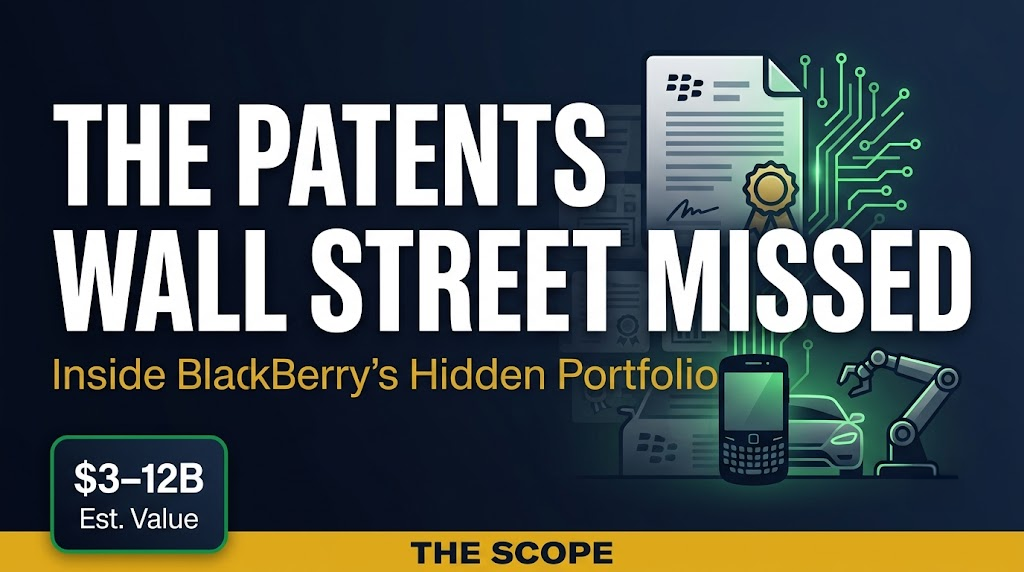
The estimated value of the full 6,100-patent portfolio ranges from $3 billion to $12 billion — currently carried at close to zero across analyst models, despite representing up to 2.7 times the company’s entire market capitalization of roughly $4.5 billion.
Defense and Physical AI: The Verticals With Zero Current Modeling
The global aerospace and defense market reached $918 billion in 2026, growing 8.4% annually. The missile defense market alone is projected to hit $53.5 billion by 2030, with the U.S. allocating $17.9 billion to its Golden Dome program for FY2027. On April 15–16, 2026, BlackBerry announced two defense contracts on consecutive days — a TKMS submarine software deal and a SecuSUITE naval partnership — sending shares up 14% with zero corresponding analyst model updates.
On June 22, 2026, QNX announced a collaboration with NVIDIA called Halos for Robotics, described by NVIDIA as the industry’s first full-stack safety system for physical AI powered by IGX. This is not a future promise — it is a live program currently accepting developer applications. At Hannover Messe 2026, a humanoid robot named AEON is scheduled to perform assembly work at BMW’s Leipzig facility using the same NVIDIA-QNX stack — the same automotive OEM relationship extending into an entirely separate market.
Key Risks
- OEMs could build their own middleware in-house, capturing data economics directly before BlackBerry secures monetization agreements
- Per-instance and V2X revenue realization could be delayed well past 2028, even if the long-term thesis proves correct
- Defense and robotics programs typically require three to seven years between contract signing and meaningful revenue recognition
A Different Kind of Benchmark: Inflation-Adjusted All-Time High
BlackBerry’s all-time high was $124 per share in September 2007 — the peak of its enterprise smartphone dominance, a fundamentally different business model than today’s company. Adjusted for the rise in average U.S. hourly wages over that period (from $17.63 to $32.31, a 1.83x multiplier), that historic peak translates to roughly $227 to $310 in today’s purchasing-power terms, depending on which wage cohort is used as the reference point.
This comparison is not a claim that today’s BlackBerry deserves the same valuation as its smartphone-monopoly predecessor. It is a way of framing what “more valuable than the historic peak” would actually need to look like in dollar terms — a useful anchor for a company now embedded in 275 million vehicles, 24 of the top 25 EV OEMs, naval submarines, NASA spacecraft, and NVIDIA’s entire physical AI safety stack.
Q1 FY2027: The Thesis Gets Stronger
BlackBerry’s June 25, 2026 earnings report beat across every metric: revenue of $152.9 million against a $138.2 million consensus, adjusted EPS of $0.04 against $0.03 expected, QNX revenue up 26% to $72.3 million at 86% margin, and total adjusted EBITDA up 144%. The company posted its first positive operating cash flow fiscal first quarter in nine years, excluding a prior patent sale.
CEO John Giamatteo specifically flagged the company’s “multi-year growth opportunities in software-defined vehicles… and the broader embedded market, particularly physical AI” as significantly enhancing QNX’s long-term potential. Full-year guidance was raised to $594 to $621 million in total revenue.
✦ THE SCOPE — KEY TAKEAWAYS
- Standard analyst models price BlackBerry on roughly two revenue streams — per-vehicle QNX royalties and Secure Communications ARR — while a direct patent review surfaces at least fifteen additional, largely unmodeled revenue opportunities.
- An estimated $3 billion to $12 billion patent portfolio is currently priced at close to zero, despite representing up to 2.7 times the company’s total market capitalization.
- Defense contracts (TKMS, SecuSUITE) and the NVIDIA Halos robotics collaboration validate expansion into physical AI and allied defense, sectors with effectively zero current analyst coverage.
- Q1 FY2027 results beat across every key metric, with the company posting its first positive operating cash flow first quarter in nine years.
- The core risk is timing, not direction — per-instance data monetization and V2X infrastructure revenue may not materialize in reported financials before 2028, even if the underlying thesis proves correct.
This content is produced by The Scope for informational purposes only and does not constitute investment advice. All investment decisions are the sole responsibility of the reader. The Scope accepts no legal liability for actions taken based on this analysis.