📡 DATA CENTER COOLING SERIES — PART 2 OF 4
Inside the Liquid Cooling Value Chain: Where the Real Margin Actually Lives
Roughly $14 billion in acquisitions over the past year reveal which part of the cooling stack industrial giants are willing to pay the steepest premiums to control.
Following the Heat From Chip to Sky
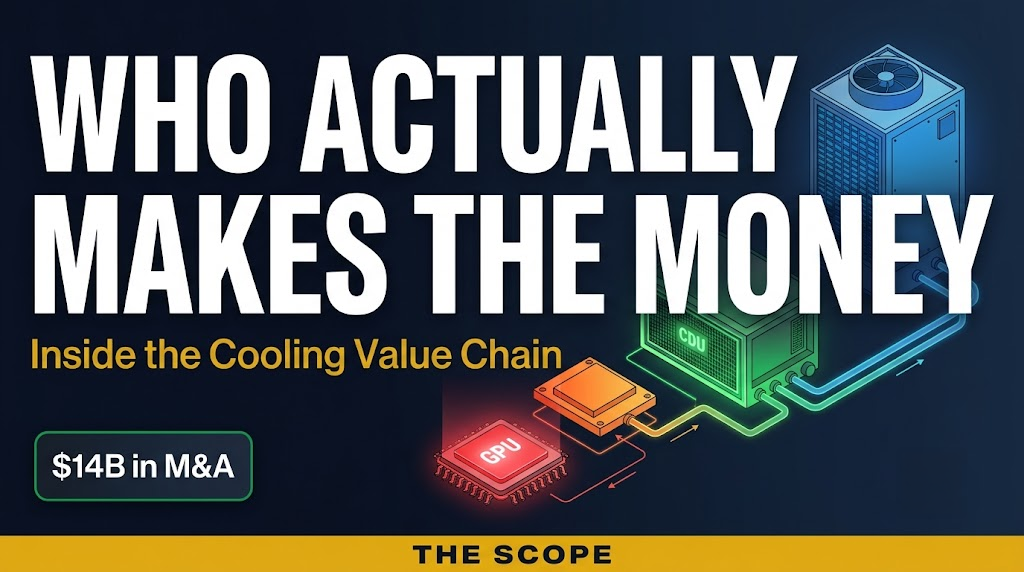
The liquid cooling value chain looks complicated until you trace a single principle through it: heat generated at the chip has to travel somewhere, and every company in this industry occupies one link in that journey. Heat is generated at the GPU, absorbed by a cold plate mounted directly on the chip, carried by coolant to a Coolant Distribution Unit (CDU) that manages flow and temperature, exchanged with a facility-level water loop, and ultimately rejected to the atmosphere through chillers or cooling towers outside the building.
Each link in that chain has a different competitive structure, different margin profile, and a different answer to the question every investor actually cares about: who captures the value as this market scales?
The Heat’s Journey: Chip to Atmosphere
GPU Chip
Cold Plate
CDU
Chiller
Atmosphere
The Acquisition Wave That Reveals Where the Value Is
The clearest signal of where industry leaders believe the margin actually sits comes from where they’ve spent their capital. Over roughly the past year, the sector has seen a wave of acquisitions concentrated specifically around CDU and cold plate technology — not the chillers, not the broader facility cooling infrastructure, but the system-level components closest to the chip.
In March 2026, Eaton closed its acquisition of Boyd Thermal for $9.5 billion, instantly adding liquid cooling scale at a premium valuation. That same month, Ecolab — a water treatment and industrial chemistry company with no prior data center cooling presence — announced a $4.75 billion acquisition of CoolIT Systems from private equity firm KKR, a deal expected to close in Q3 2026. CoolIT brought existing design partnerships with both NVIDIA and AMD for custom cold plates, along with an HPE collaboration on high-performance computing systems — credibility that would have taken years to build organically.
Major Liquid Cooling M&A — Past 18 Months
| Eaton → Boyd Thermal | $9.5B · March 2026 · CDU and cold plate scale |
| Ecolab → CoolIT Systems | $4.75B · March 2026 (from KKR) · NVIDIA/AMD design partnerships |
| Schneider Electric → Motivair | $850M · October 2024 · Cold plate technology, CDU manufacturing |
Every major deal targeted the same layer of the value chain: cold plates and CDUs, the components that sit closest to the chip and require the deepest engineering relationships with NVIDIA and AMD.
Why the CDU Layer Commands the Premium
It would be reasonable to assume the chip-adjacent cold plate — the component in direct physical contact with the GPU — captures the most value. The acquisition pattern suggests something more specific: the CDU layer, which orchestrates flow and temperature across an entire rack or row of racks, is where the deepest technical moat actually sits.
A CDU isn’t a commodity pump. It requires precision engineering to manage flow rates, temperature differentials, and failure detection across systems running at 120-plus kilowatts continuously, where a malfunction can damage hundreds of thousands of dollars of GPU hardware in minutes. That reliability requirement, combined with the need for deep co-engineering relationships with NVIDIA on reference architectures, creates switching costs that are difficult for new entrants to replicate quickly — which is precisely why incumbents have been willing to pay double-digit-billion-dollar premiums to acquire that capability rather than build it from scratch.
The Big Three: Cooling Infrastructure Vendors
$2.65B
Adjusted diluted EPS +83% YoY; backlog exceeds $15B
~$1.7B
Projected 2026 revenue contribution from Boyd acquisition
+78% YoY
Fiscal Q3 2026, with full-year guidance raised to 15–20% growth
Three Different Bets on the Same Theme
Vertiv has positioned itself as the closest thing to a pure-play on this trend, with data center infrastructure representing more than 80% of revenue and a backlog exceeding $15 billion that provides roughly 12 to 18 months of forward revenue visibility. That concentration cuts both ways — it offers maximum exposure to the cooling buildout, but also maximum vulnerability if AI infrastructure spending decelerates.
Eaton represents the opposite end of the spectrum: a diversified industrial conglomerate where data center cooling is one growth vector among many, with its broad electrical and power management portfolio providing earnings stability that a pure-play cannot match. Schneider Electric occupies similar diversified territory, though it trades primarily on European exchanges and remains less directly accessible to U.S. retail investors. Modine sits as the smaller, faster-growing pure-play alternative to Vertiv, with data center sales now compounding at triple-digit-adjacent rates off a smaller revenue base.
What to Watch
- Premium M&A valuations across the sector mean further consolidation could come at increasingly steep prices, raising integration and execution risk for acquirers
- Pure-play exposure (Vertiv, Modine) offers higher upside but greater sensitivity to any slowdown in AI infrastructure capital expenditure
- Diversified industrials (Eaton, Schneider) offer more stable earnings but a diluted impact from exceptional cooling segment growth
✦ THE SCOPE — KEY TAKEAWAYS
- The liquid cooling value chain runs from chip to cold plate to CDU to chiller to atmosphere — and roughly $14 billion in recent M&A has concentrated specifically on the cold plate and CDU layers.
- The CDU layer commands premium acquisition pricing because it requires precision engineering, deep NVIDIA co-design relationships, and reliability at failure-critical thresholds.
- Vertiv stands as the closest pure-play with an $15B+ backlog, while Eaton, Schneider, and Modine offer varying degrees of diversification within the same theme.
- Outside acquirers like Ecolab — a water treatment company with no prior data center presence — are paying multi-billion-dollar premiums to enter this value chain, signaling how strategically important the sector has become.
- The next installment in this series examines how NVIDIA’s reference architecture program controls which suppliers gain access to this value chain in the first place.
This content is produced by The Scope for informational purposes only and does not constitute investment advice. All investment decisions are the sole responsibility of the reader. The Scope accepts no legal liability for actions taken based on this analysis.