🔋 ESS BATTERY SERIES — PART 3 OF 4
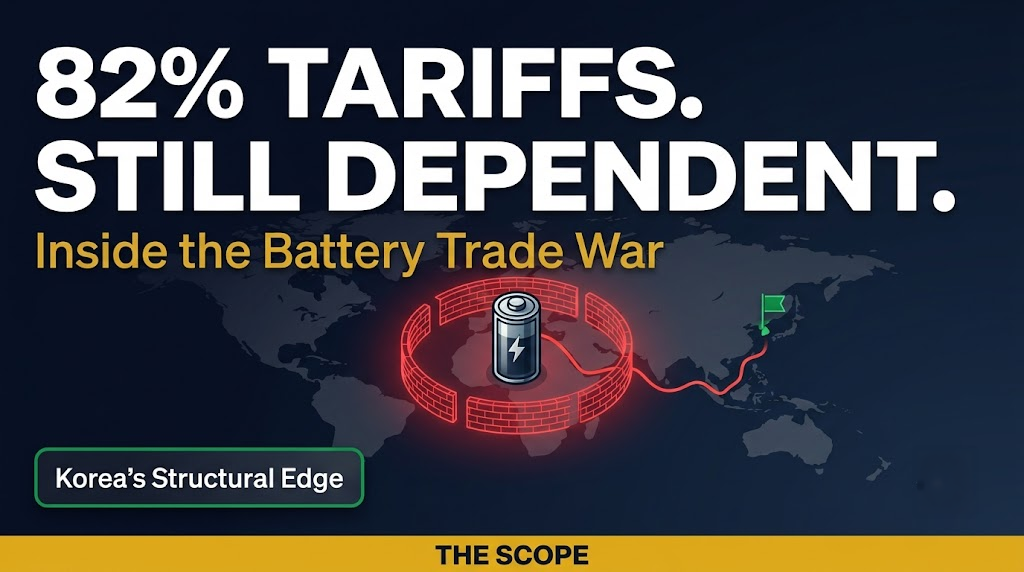
Tariffs Just Made Chinese Batteries 82% More Expensive — But the U.S. Still Can’t Quit Them
A web of tariffs, export restrictions, and tax credits is trying to rewire global battery supply chains. So far, geography is winning the argument that policy is trying to fight.
The Uncomfortable Starting Point
Before examining any policy response, it’s worth sitting with the scale of the problem U.S. and European policymakers are actually trying to solve. China controls roughly 85% of global lithium-ion battery cell production, channeled primarily through CATL, BYD, and EVE Energy. For LFP specifically — the chemistry that dominates grid-scale storage — China’s grip on cathode active material production exceeds 90%. This isn’t a market share advantage that shifts in a single policy cycle; it reflects two decades of compounding investment in mining, refining, cell manufacturing, and the specialized engineering talent that supports all of it.
Every tariff, export restriction, and tax credit examined in this piece operates against that backdrop. The policy tools are real and consequential. The underlying structural dependency they’re trying to overcome is larger than any single piece of legislation.
Global Battery Cell Production by Country
China
China (~85%)
South Korea & Japan (~10%)
Rest of world (~5%)
The Tariff Escalation: From 7.5% to 82.4% in Two Years
The U.S. tariff regime on Chinese batteries has escalated dramatically and in stages. Chinese LFP cells, which faced a 7.5% Section 301 tariff before 2025, now carry a combined rate that reaches 82.4% once the full schedule of step-ups takes effect in 2026 — a layered stack combining baseline tariffs, reciprocal trade measures, and pre-existing Section 301 escalations originally planned under the Biden administration. The effect on landed cell prices is direct: industry analysts at Rho Motion calculate that 65%-range tariffs alone could push LFP cell prices from the $60–70/kWh range back toward $100/kWh — effectively erasing roughly two years of the price declines covered earlier in this series.
Tariff Escalation Timeline — Chinese LFP Cells for ESS
Combined Section 301, reciprocal, and baseline tariffs on Chinese LFP cells have escalated more than tenfold in under two years.
Why Tariffs Alone Aren’t Solving the Dependency Problem
Here is the structural irony policymakers are confronting: even at an 82% tariff rate, the U.S. storage market is expected to continue relying heavily on Chinese cells, simply because domestic alternatives don’t yet exist at meaningful scale. Industry analysts have been blunt about this — with domestic LFP cell manufacturing still nascent, U.S. buyers face a choice between expensive Chinese cells or no cells at all, and “expensive but available” tends to win in the near term regardless of the tariff math.
This is precisely why the policy response has expanded beyond tariffs into supply chain compliance mechanisms. Foreign Entity of Concern (FEOC) regulations, implemented under the IRA and subsequent guidance, disqualify products with sufficient involvement from Chinese, Russian, North Korean, or Iranian entities from federal tax incentives — and the rules apply not just to final cell assembly but to every major material input: cathode active material, anode material, electrolyte, and separator. Compliance now requires tracing material origin across the entire supply chain, a documentation burden that itself functions as a structural barrier favoring companies already deep into supply chain diversification.
Three Policy Levers, Three Different Targets
| Section 301 Tariffs | Raises the cost of importing Chinese cells directly, up to 82.4% in 2026 |
| IRA Production Tax Credit | Pays domestic manufacturers $35/kWh to build cells in the U.S., closing the cost gap |
| FEOC Compliance Rules | Disqualifies products with Chinese-linked materials from federal incentives entirely |
Korea’s Structural Opening
If there’s a clear winner emerging from this policy environment, it’s South Korea’s battery manufacturers. With Chinese cells facing punitive tariffs and FEOC restrictions, and with domestic U.S. manufacturing still years from meaningful scale, Korean producers — LG Energy Solution, Samsung SDI, and SK On — occupy a rare structural position: established manufacturing expertise, existing U.S. production footprints, and FEOC-compliant supply chains that Chinese competitors cannot easily replicate.
LG Energy Solution’s Michigan facility and planned Arizona plant represent the most advanced domestic LFP cell production pipeline among non-Chinese suppliers, positioning the company to capture customers who need FEOC-compliant cells but can’t yet source them from purely domestic American manufacturers. Samsung SDI and SK On are pursuing parallel strategies. None of this is charity — it’s the direct, intended outcome of a policy architecture designed specifically to advantage non-Chinese, allied-nation suppliers.
What Could Change the Trajectory
- IRA production tax credits could be reduced or eliminated through future legislation, removing the economic incentive supporting domestic manufacturing buildout
- Chinese manufacturers expanding production in Southeast Asia could create new tariff-advantaged sourcing routes that partially bypass current restrictions
- Trade negotiations or legal challenges could alter tariff rates on specific materials before the full 2026 schedule takes effect
Why the Structural Shift Still Matters
- Domestic battery manufacturing investment from the IRA era is largely locked in and unlikely to fully reverse even if future subsidies are reduced
- Defense and federal procurement requirements create durable demand for FEOC-compliant supply chains independent of tariff levels
- Korean manufacturers’ head start in U.S.-based production gives them a multi-year advantage that’s difficult for Chinese competitors to erase through pricing alone
✦ THE SCOPE — KEY TAKEAWAYS
- Combined U.S. tariffs on Chinese LFP cells have escalated from 7.5% to a scheduled 82.4% by 2026, pushing landed prices back toward 2022 levels.
- Despite punitive tariffs, the U.S. storage market is expected to remain dependent on Chinese cells in the near term, since domestic manufacturing alternatives don’t yet exist at sufficient scale.
- FEOC compliance rules extend restrictions across the entire supply chain — cathode material, anode material, electrolyte, and separator — not just final cell assembly.
- South Korean manufacturers, particularly LG Energy Solution, Samsung SDI, and SK On, occupy a structurally advantaged position as the clearest near-term beneficiaries of this policy environment.
- The final installment in this series examines the actual investable companies across this value chain — which names are positioned to benefit, and which carry the most geopolitical risk.
This content is produced by The Scope for informational purposes only and does not constitute investment advice. All investment decisions are the sole responsibility of the reader. The Scope accepts no legal liability for actions taken based on this analysis.