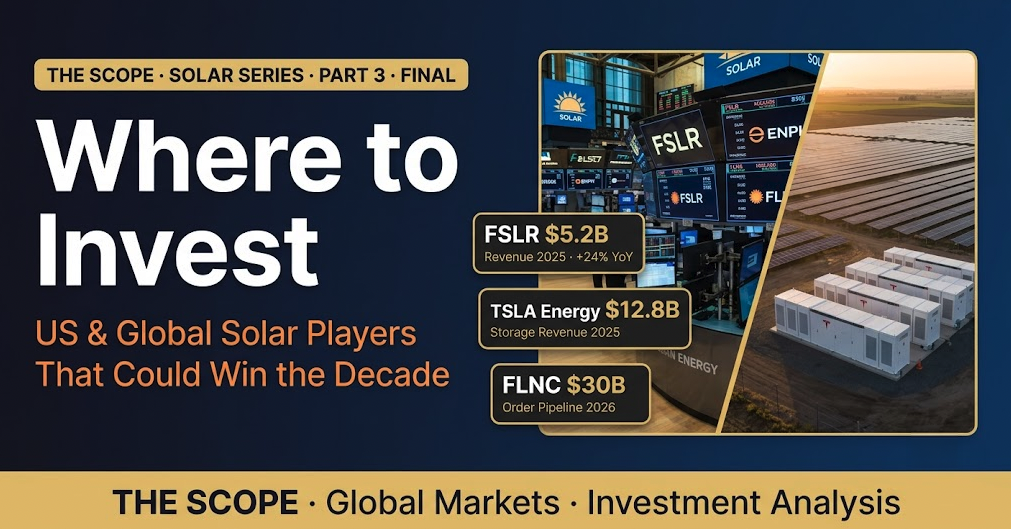
FIRST SOLAR FY2025
$5.2B
Revenue · +24% YoY · 18GW capacity by 2027
TESLA ENERGY FY2025
$12.8B
Revenue · +27% YoY · 46.7 GWh deployed
FLUENCE FY2026 GUIDE
$3.4B
Revenue midpoint · $30B pipeline · +30% YoY
The Investment Map: Who Actually Wins the Solar Decade?
Parts 1 and 2 of this series established the structural case: solar technology has undergone a historic cost collapse, AI is driving unprecedented electricity demand growth, and the solar-plus-storage combination is the defining infrastructure investment of this decade. The harder question — the one that separates observation from actionable investment insight — is which specific companies are positioned to capture that value.
The answer is not obvious. The solar industry’s oversupply crisis means that Chinese module manufacturers — who dominate global production — are largely selling below cost. European utilities are navigating a complex regulatory environment. And American solar companies face a bifurcated reality: protected from Chinese competition by tariffs, but exposed to the political risk of IRA policy changes. This analysis focuses on the US and global players most likely to generate durable returns — companies with structural competitive advantages, not just exposure to a growing market.
First Solar (FSLR): America’s Only Large-Scale Module Manufacturer
First Solar occupies a unique position in the global solar industry. It is the only US-headquartered company among the world’s largest solar module manufacturers, and the only major producer using thin-film cadmium telluride (CdTe) technology rather than conventional silicon. That distinction, which once seemed like a technological liability, has become its most powerful competitive weapon in the tariff era.
The financial results reflect the structural advantage. In FY2025, First Solar reported revenue of $5.2 billion — a 24% year-over-year increase. Q1 2026 revenue reached $1.04 billion, up 24% from the prior year period, with net income of $346.6 million and a 33% profit margin. The company ended 2025 with a net cash balance of $2.4 billion, providing substantial financial flexibility. For FY2026, First Solar guides for net sales of $4.9–5.2 billion with adjusted EBITDA of $2.6–2.8 billion — a margin profile that Chinese module manufacturers can only dream about in the current oversupply environment.
The IRA’s Section 45X manufacturing tax credits are central to First Solar’s economics. In 2024 alone, the company sold $857 million of 45X tax credits to third parties — a direct cash inflow that reflects the substantial value of domestic manufacturing in the current policy environment. With a new South Carolina facility expected to add 3.7 GW of capacity and bring total US nameplate capacity to approximately 18 GW by 2027, First Solar’s scale advantage in the domestic market is widening.
The key risk is policy. If the 45X tax credits are significantly curtailed — a possibility that has weighed on the stock — the earnings profile changes materially. First Solar has responded by emphasizing that its thin-film technology, US manufacturing footprint, and tariff protection create a floor under its competitive position that exists independently of subsidies. The recently announced patent license with Oxford PV for perovskite technology signals that the company is also preparing for the next technology generation.
Enphase Energy (ENPH): Microinverters, Batteries, and the Data Center Pivot
Enphase Energy is the world’s leading supplier of microinverter-based solar and battery systems — a position built on a technology architecture that distributes power conversion to each individual panel rather than centralizing it in a single string inverter. The result is higher efficiency, better monitoring, and superior performance in partially shaded conditions. For residential and commercial solar, where panel-level optimization matters, Enphase’s architecture commands a premium.
FY2025 revenue reached approximately $1.5 billion, with Q3 2025 representing the highest quarterly revenue in two years at $410.4 million. The company’s non-GAAP gross margins — consistently in the 43–49% range — reflect the premium pricing power that proprietary technology enables. Unlike module manufacturers selling commodity products in a price war, Enphase sells differentiated systems where the software and integration layer create switching costs and recurring revenue.
The most strategically significant development in 2026 is Enphase’s announced pivot into AI data center infrastructure. In Q1 2026, the company announced the development of the IQ Solid-State Transformer (SST) — a distributed power conversion platform purpose-built for AI data centers. The SST converts medium-voltage AC directly to 800V DC in a single stage, offering higher efficiency and a more modular architecture than conventional transformer-based systems. Pilots are planned for 2027, with volume shipments targeting 2028. If the technology scales, Enphase gains access to a commercial market that could be substantially larger than its residential core.
CORE BUSINESS
Residential + Commercial Solar
- World #1 microinverter supplier
- IQ9 GaN microinverter: higher power, FEOC compliant
- ~43–49% non-GAAP gross margins
NEW GROWTH VECTOR
AI Data Center Infrastructure
- IQ SST: medium-voltage AC → 800V DC, single stage
- Pilots 2027, volume shipments 2028
- Targets $400M+ commercial microinverter market
Tesla Energy (TSLA): The Megapack Empire
Tesla’s energy storage business is the most overlooked division at one of the world’s most closely watched companies. While headlines focus on vehicle deliveries, Tesla Energy posted $12.8 billion in revenue for FY2025 — a 27% year-over-year increase — with 46.7 GWh of storage deployed across the year. By Q4 2025, quarterly storage deployments hit a record 14.2 GWh, and preliminary Q1 2026 data suggests deployments exceeding 15 GWh — another quarterly record.
The Megapack is Tesla’s flagship utility-scale product — a containerized battery system designed for grid-scale deployment alongside solar farms, wind projects, and standalone grid stabilization. Tesla operates Megafactories in Lathrop, California and Shanghai, with a third facility under development in Brookshire, Texas, expected to contribute to production in late 2026. The Megapack 3, unveiled in late 2025, offers 5 MWh of usable energy per unit — higher density than its predecessor — along with a 40% reduction in construction costs and 23% faster installation.
The strategic positioning is compelling. Global energy storage deployments are projected to grow from approximately 100 GWh annually in 2025 to over 500 GWh by 2030 (BloombergNEF). Tesla, with its manufacturing scale, brand recognition, and integrated software platform, is positioned as a structural beneficiary of this growth regardless of what happens to the EV business. Energy is now 13% of Tesla’s total revenue — up from 10% in 2024 — and the trajectory suggests it will become an increasingly dominant portion of the revenue mix through the end of the decade.
TESLA ENERGY · GROWTH TRAJECTORY
46.7 GWh
2025 deployments (+67% vs 2024)
$12.8B
FY2025 energy revenue
13%
Share of Tesla total revenue (2025)
3 plants
Megafactories: CA + Shanghai + TX (2026)
Fluence Energy (FLNC): The Pure-Play Grid Storage Bet
Fluence Energy is the most direct pure-play investment in utility-scale energy storage — a joint venture originally formed by Siemens and AES that has since become an independent publicly traded company. Unlike Tesla, which sells hardware, or First Solar, which sells modules, Fluence operates as a fully integrated storage solutions provider: it designs, procures, delivers, and operates grid-scale battery systems, with a growing software layer that manages energy dispatch and grid services.
The backlog and pipeline numbers tell the growth story. Fluence’s project pipeline has grown approximately 30% to $30 billion since September 2025 — driven by accelerating data center demand, utility procurement, and rising industrial loads. For FY2026, the company guides revenue of $3.2–3.6 billion (midpoint $3.4 billion), with the midpoint fully covered by orders already in backlog. The CEO highlighted in Q2 2026 earnings that the company has signed master supply agreements with two hyperscalers and expects to convert its first hyperscaler order soon.
The profitability profile is still maturing. Gross margins of approximately 10% reflect the project execution nature of the business — Fluence manages complex, multi-year contracts with significant supply chain and execution risk. The company is investing in its Smartstack product (a pre-integrated, modular storage system designed to reduce installation time and costs) and its domestic content strategy to capture IRA incentives for US projects. As the business scales and the software layer matures, margins are expected to expand — but investors should treat Fluence as a high-growth, execution-risk story rather than a margin-quality compounder.
The Global Dimension: Sungrow and the Infrastructure Layer
No analysis of the solar investment landscape is complete without acknowledging that China’s manufacturers — despite their oversupply crisis — remain the dominant force in global solar technology. LONGi and JinkoSolar hold the world efficiency records for tandem solar cells. Sungrow, the world’s largest inverter manufacturer with over 700 GW of cumulative installed capacity, is expanding aggressively into battery storage and is increasingly present in US and European markets through partnerships and local manufacturing.
For US and European investors, direct investment in Chinese solar manufacturers carries elevated geopolitical and regulatory risk — US tariffs, potential FEOC restrictions on battery supply chains, and the broader US-China technology decoupling create an uncertain investment environment. However, understanding the Chinese competitive landscape is essential for evaluating the durability of First Solar’s moat, the trajectory of global module prices, and the timeline for perovskite tandem commercialization — since Chinese manufacturers are leading the technology race.
The more accessible global investment angle is through grid infrastructure — the often-overlooked but structurally necessary complement to solar and storage deployment. Every gigawatt of new solar capacity requires grid-side investment: transformers, switchgear, transmission cables, and increasingly, grid-forming inverters that can maintain frequency stability as conventional synchronous generation is replaced by variable renewables. Companies like Eaton, ABB, and Siemens Energy — which supply the electrical infrastructure that makes the energy transition physically possible — offer exposure to the solar build-out with less technology and policy risk than pure-play solar companies.
Series Conclusion: The Framework for Thinking About Solar Investments
Across three parts, this series has traced the arc of solar from a 1970s space technology to the central infrastructure investment of the AI era. The through-line is clear: costs have fallen in a way that has permanently changed the economics of electricity generation, and AI-driven demand growth has arrived just as the technology reached price competitiveness with every alternative.
But the investment opportunity is not as simple as “buy solar.” The industry is in a severe oversupply crisis that will eliminate weaker players and compress margins for years. Policy changes in the US create genuine uncertainty around IRA subsidies. And the technology transition from TOPCon to perovskite tandem will reshape competitive hierarchies in ways that are not yet clear.
The framework that emerges from this analysis: favor companies with structural competitive advantages that exist independently of subsidies; look for exposure to the storage layer, where the structural demand from AI and grid stabilization is strongest; and treat the Chinese technology race as a monitoring signal for the next technology generation rather than a direct investment opportunity for most Western investors.
✦ THE SCOPE · PART 3 KEY TAKEAWAYS
- First Solar is the only large-scale US module manufacturer with structural tariff protection, 45X manufacturing credits, and a unique thin-film technology. FY2025 revenue of $5.2B at 33%+ margins is exceptional in the current environment.
- Enphase Energy’s pivot into AI data center infrastructure — the IQ SST solid-state transformer — is the most strategically significant new product announcement in the solar sector in 2026, with pilots in 2027 and volume shipments targeted for 2028.
- Tesla Energy is the fastest-growing large-cap storage business globally: $12.8B revenue, 46.7 GWh deployed in 2025, and Megapack 3 launching with 40% lower construction costs — largely invisible to investors fixated on the EV narrative.
- Fluence Energy’s $30 billion pipeline and signed hyperscaler agreements position it as the pure-play grid storage beneficiary of data center growth — but investors should expect margin volatility as the business scales.
- Grid infrastructure companies (Eaton, ABB, Siemens Energy) offer underappreciated exposure to the solar build-out without the policy and technology risk of pure-play solar manufacturers.
THE SCOPE · SOLAR SERIES · COMPLETE
PART 1
50 Years of Tech & The Oversupply Crisis
PART 2
AI Is Eating the Grid: Solar + ESS Through 2030
PART 3 · YOU ARE HERE
Where to Invest: US & Global Solar Players
This content is produced by The Scope for informational purposes only and does not constitute investment advice. All investment decisions are the sole responsibility of the reader. The Scope accepts no legal liability for actions taken based on this analysis.